About Ostrya virginiana (Mill.) K.Koch
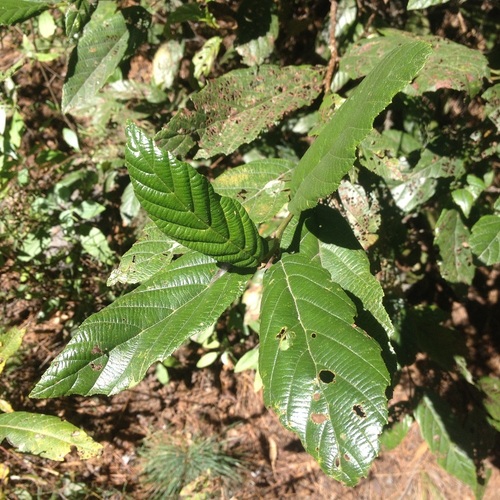
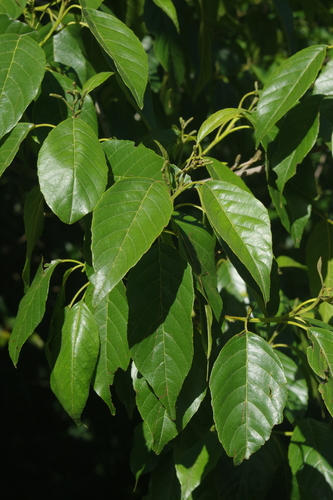
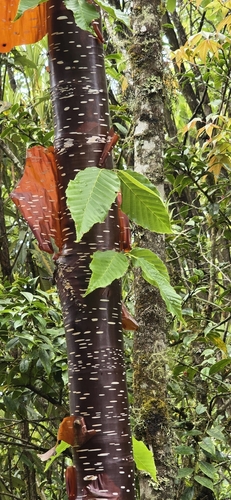
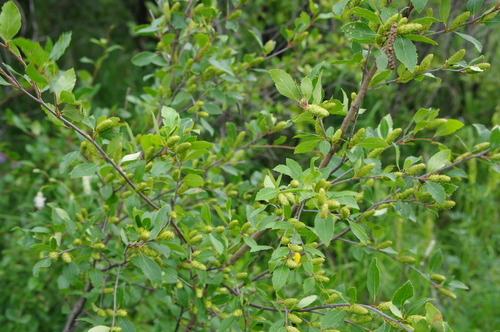
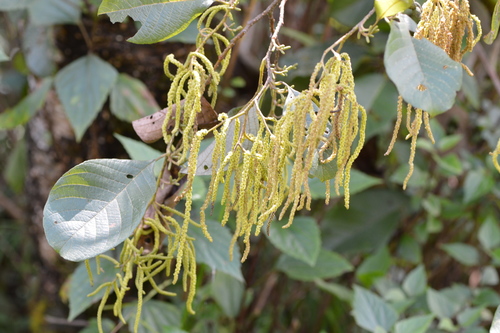
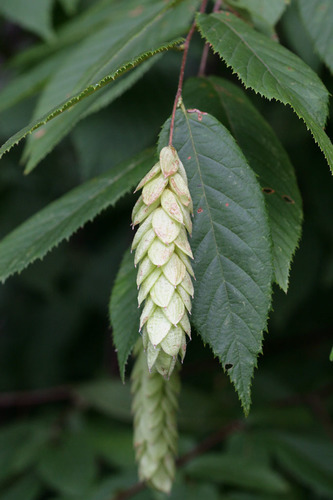
Ostrya virginiana, commonly called American hophornbeam, is a small deciduous understory tree. It reaches a maximum height of 18 m (59 ft), with a trunk diameter between 20 and 50 centimetres (8–20 in). The bark ranges from brown to gray-brown, and peels in narrow, shaggy plates. Younger twigs and branches are smoother, gray, and marked with small lenticels. Very new twigs have sparse to thick fuzzy hairs (trichomes), which are shed by the following year. The leaves are ovoid-acute in shape, measuring 5–13 cm (2–5 in) long and 4–6 cm (1+1⁄2–2+1⁄4 in) wide. They have pinnate venation and doubly serrated margins. The upper leaf surface is mostly hairless, while the lower surface ranges from sparsely to moderately fuzzy, rarely being densely hairy. Flowers are catkins (spikes) that emerge in early spring, at the same time new leaves appear. Staminate (male) catkins are 2–5 cm (3⁄4–2 in) long, and grow in groups of 1 to 4. Pistillate (female) catkins are 8–15 mm (5⁄16–19⁄32 in) long, and each holds 10 to 30 individual flowers. After pollination, female flowers develop into small 3–5 mm (1⁄8–3⁄16 in) long nutlets. Each nutlet is fully enclosed in a papery, sac-shaped involucre that is 10–18 mm (3⁄8–11⁄16 in) long and 8–10 mm (5⁄16–3⁄8 in) wide. The involucre changes from greenish-white to dull brown as the fruit matures. American hophornbeam is closely related to American hornbeam (Carpinus caroliniana), and can be told apart from that species by American hornbeam’s smooth bark and nutlets enclosed in open, three-lobed bracts. Ostrya virginiana grows in temperate regions of the United States and Canada, where it occurs in lowland and foothill forests, and is almost always found as an understory tree. In Mexico and Central America, it grows in cloud forests and humid sections of mid-elevation oak, pine–oak, and pine forests, at elevations between 1200 and 2800 meters. The buds and catkins are an important winter food source for some birds, most notably ruffed grouse (Bonasa umbellus). Birds, deer, and rabbits also eat the tree’s nutlets and buds. It is not commonly cultivated as an ornamental plant, but is sometimes planted as a street tree. Its wood is very resilient, and is valued for manufacturing tool handles and fence posts. As a diffuse porous hardwood with extremely high density and compression resistance, it is an excellent material for constructing wooden longbows.