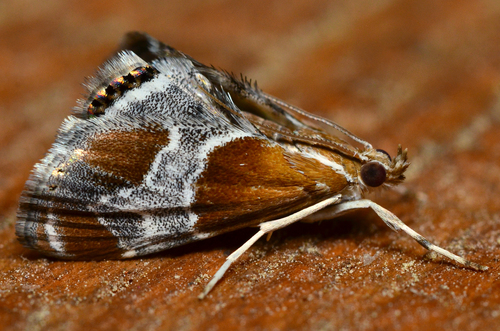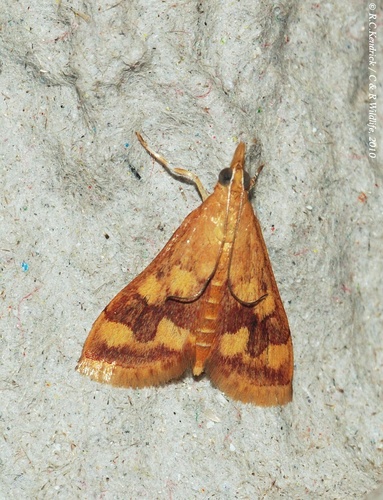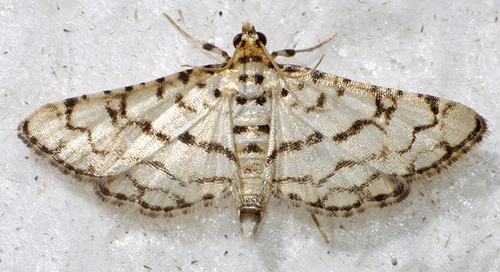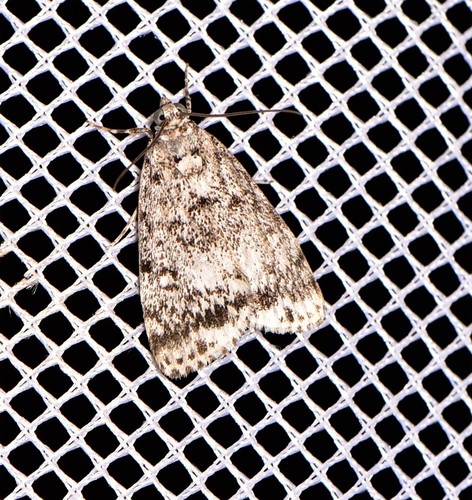
About Ostrinia furnacalis (Guenée, 1854)
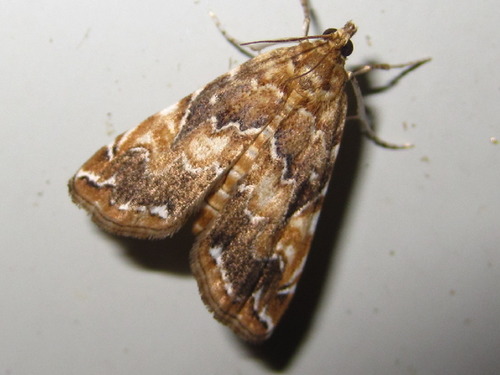
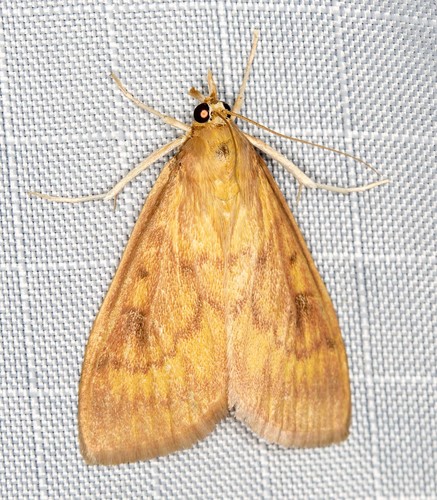
Ostrinia furnacalis is a moth species in the grass moth family Crambidae, described by Achille Guenée in 1854. It has the common name Asian corn borer, as it occurs across Asia and feeds primarily on corn. This moth ranges from China through Southeast Asia and Island Southeast Asia to Australia, with documented populations in Java, Sulawesi, the Philippines, Borneo, New Guinea, the Solomon Islands, and Micronesia. It belongs to the Ostrinia species complex, where member species are difficult to distinguish by appearance. O. furnacalis may occur alongside other Ostrinia species such as O. orientalis, O. scapulalis, O. zealis, and O. zaguliaevi, and these taxa cannot be easily told apart. This species performs unique acoustic mimicry of a predator: it mirrors the echolocation calls of bats to temporarily paralyze female moths, making mating easier. It is a well-known agricultural pest affecting multiple crops in the western Pacific region of Asia, with a particular preference for corn. It ranks as the second most prevalent corn pest, only preceded by maize downy mildew. Extensive research is currently underway in Asia to eradicate this pest from corn crops, including research into the use of biological agents and toxins. Its core geographic range spans most of Asia and Southeast Asia, specifically found in China, the Philippines, Indonesia, Taiwan, Malaysia, Thailand, Sri Lanka, India, Bangladesh, Japan, Korea, Vietnam, Laos, Myanmar, and Cambodia. Smaller populations also exist in the Solomon Islands, Africa, and parts of Australia. The Asian corn borer survives best in tropical regions, where continuous year-round farming of its host crops provides constant food resources. While corn is its main food source, it also feeds on and damages bell pepper, cotton, hops, millet, pearl millet, foxtail millet, sugarcane, sorghum, and ginger. It can also be found living on a variety of wild plants including wormwoods, Job's tears, knotweeds, wild sugarcane, Johnson grass, and para grass.