About Osteospermum moniliferum L.
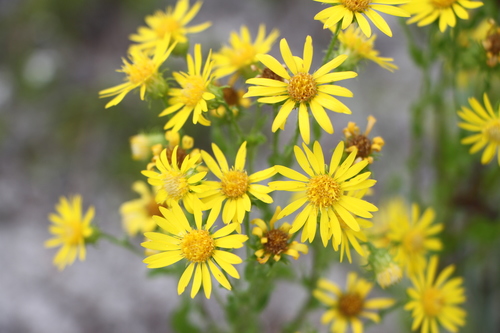
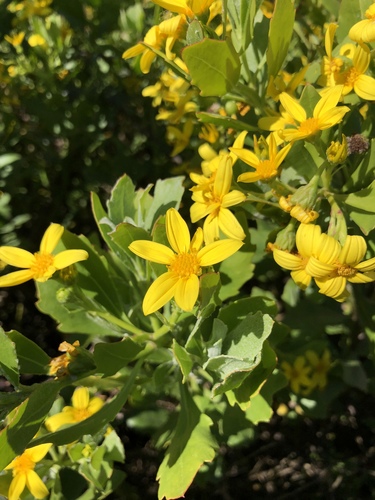
Osteospermum moniliferum L., commonly known as boneseed, is a perennial woody upright shrub that usually grows to 3 m (9.8 ft) tall, and occasionally reaches greater heights. It belongs to the Asteraceae (daisy) family, and produces showy bright yellow flowers. These flowers have 5 to 8 ray florets ('petals') arranged in a swirl, and can measure up to 30 mm (1.2 in) across. Its fruit are berry-like and spherical, reaching around 8 mm in diameter. As the fruit matures, it turns dark brown to black, and contains a 6–7 mm diameter bone-colored seed inside. Its leaves measure 2–6 cm (0.79–2.36 in) long by 1.5–5 cm (0.59–1.97 in) wide. They are oval-shaped, taper toward the base, and have irregularly serrated (toothed) margins.
Bitou bush can be partially distinguished from boneseed by its growth traits: bitou bush has a more rounded, sprawling growth habit, reaching only 1.5–2 m (4.9–6.6 ft) tall, has less visibly toothed leaf margins, and produces egg-shaped rather than spherical seeds. However, boneseed and bitou bush hybridise easily, so plants with a mix of both species' traits can occur. Reproduction in O. moniliferum requires pollinators to produce seed.
In its native range, Osteospermum moniliferum grows naturally in coastal areas of South Africa, and its distribution extends into Lesotho, Zimbabwe, and southern Mozambique. Different subspecies occupy distinct native ranges. Subspecies rotundatum is concentrated along South Africa's eastern coast, from the southern tip of the country through KwaZulu-Natal to southern Mozambique. Subspecies moniliferum is concentrated around Cape Town and the Cape Peninsula on South Africa's southwestern coast, where its native habitats include Cape Flats Dune Strandveld. Subspecies canescens is native to KwaZulu-Natal, the Northern Provinces, and the Free State of South Africa, as well as to Lesotho. Subspecies septentrionale is native to Mozambique, Zimbabwe, and South Africa's Northern Province.