About Osteolaemus tetraspis Cope, 1861
Size and Species Ranking
Osteolaemus tetraspis, commonly called the dwarf crocodile, reaches an adult length of 1.7 to 1.9 meters (5.6 to 6.2 feet), and adult individuals typically weigh between 18 and 32 kilograms (40 to 71 pounds). This makes it the smallest living crocodile species, though Cuvier's dwarf caiman (Paleosuchus palpebrosus), an alligatorid species, is smaller with a maximum length of around 1.7 meters (5.6 feet). If the Congo dwarf crocodile (O. osborni) is recognized as a separate valid species, it would become the smallest crocodile and the smallest crocodilian overall, as it never grows longer than 1.2 meters (3.9 feet).
Adult Coloration
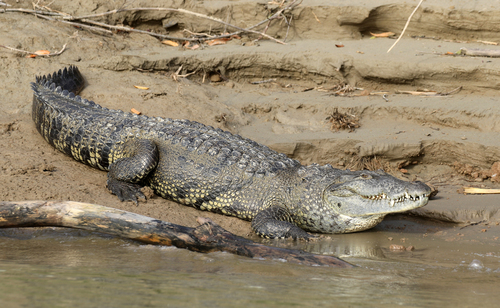
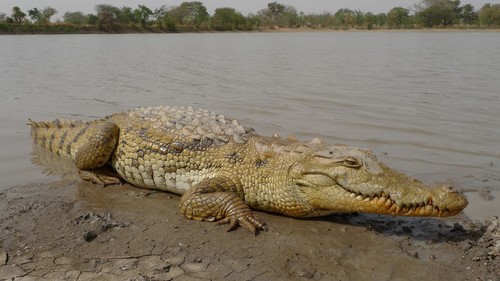
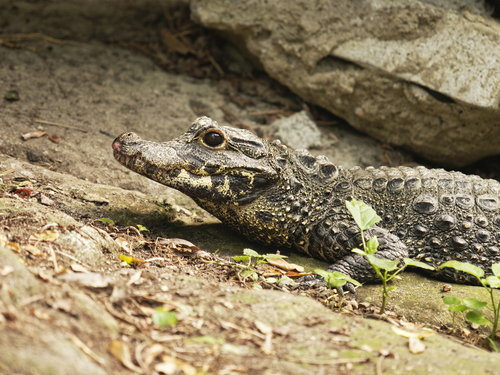
Adult dwarf crocodiles are fully dark on their upper body and sides, while their underside is yellowish with black patches. Some individuals found in the caves of Abanda, Gabon, have orange patches on their skin, which is thought to be caused by alkaline bat guano eroding their skin.
Juvenile Coloration
Juveniles have lighter brown banding across their bodies and tails, with yellow patterns on their heads.
Protective Armor
Because of their small size and higher vulnerability to predation, dwarf crocodiles have heavy armor covering their neck, back, and tail, and also have osteoderms on their belly and the underside of their neck.
Snout Morphology
The genus Osteolaemus has a short, blunt snout that is as long as it is wide, similar to the snout of Cuvier's dwarf caiman. This similar shape is likely a result of both species occupying similar ecological niches.
Dental Structure
Dwarf crocodiles have four premaxillary teeth, 12 to 13 maxillary teeth, and 14 to 15 dentary teeth.
Subspecies Differences
The nominate subspecies O. t. tetraspis has lighter coloring, a more pointed, upturned snout, and more body armor than O. t. osborni.
Geographic Range
Dwarf crocodiles are distributed across tropical Sub-Saharan West Africa and Central Africa. Their distribution overlaps heavily with that of the slender-snouted crocodile, covering areas from Senegal in the far west to Uganda in the east, and reaching as far south as Angola.
Uganda Population Status
The last confirmed sighting of dwarf crocodiles in Uganda was in the 1940s, and it remains unclear whether the easily overlooked species still survives there — the species was always marginal in Uganda, only present in the far southwest of the country.
Preferred Aquatic Habitats
Dwarf crocodiles inhabit streams, small rivers, swamps, pools and mangroves from lowlands to mid-altitude, and generally avoid the main channels of large rivers. Most of their range falls within forested regions, but they can also extend into more open areas as long as the local streams or rivers are well-shaded. They are also found in seasonally flooded forests.
Terrestrial and Unusual Habitats
Unlike most crocodile species, dwarf crocodiles rarely bask in the sun. They may move some distance away from water onto land during the night. There are also reports of dwarf crocodiles living in isolated pools in the savannah. A population of long-term cave-dwelling dwarf crocodiles is known from western Gabon, which forms a distinct isolated genetic group.
Breeding Season Timing
Dwarf crocodiles only interact closely with one another during the breeding season. Females build mound nests at the start of the wet season, which falls in May and June.
Nest Construction
Nests are built near water, as mounds of wet, decaying vegetation. Decomposition of the plant material generates heat that incubates the eggs.
Egg Laying and Incubation
Females lay a small number of eggs per clutch, usually around 10, and can lay up to 20 in extreme cases. Eggs incubate for 85 to 105 days before hatching. Newly hatched crocodiles measure 28 centimeters when they emerge from their eggs.
Parental Care
The female guards the nest throughout incubation, and continues to watch over the young for an unknown length of time after hatching, as young dwarf crocodiles can be preyed on by a wide range of predators including birds, fish, mammals, and reptiles, even other crocodiles.