About Osmia spinulosa (Kirby, 1802)
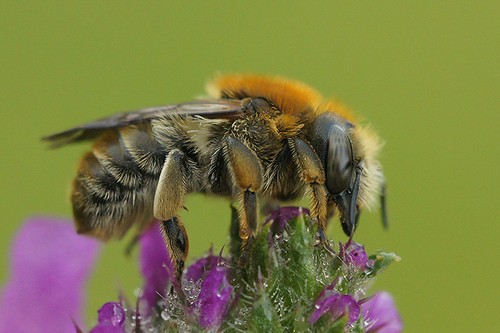
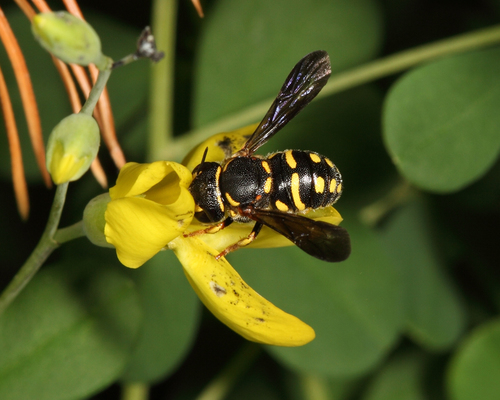
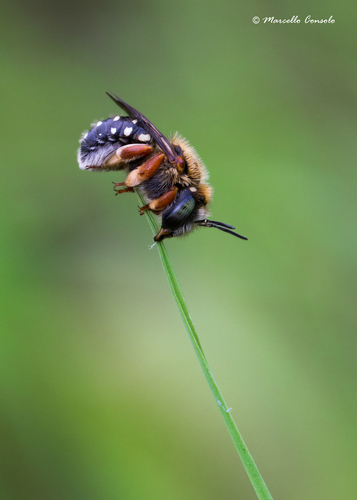
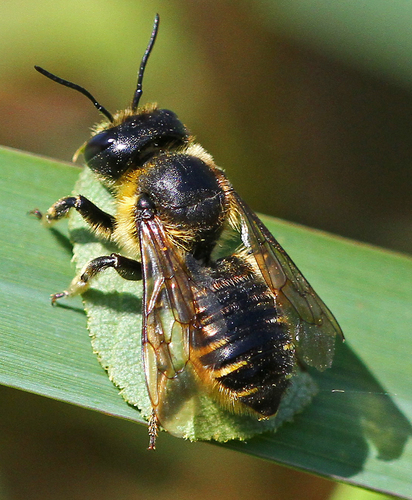
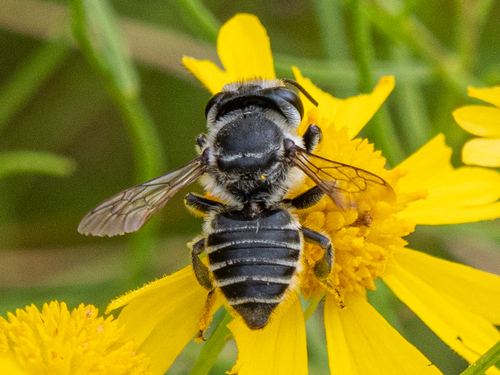
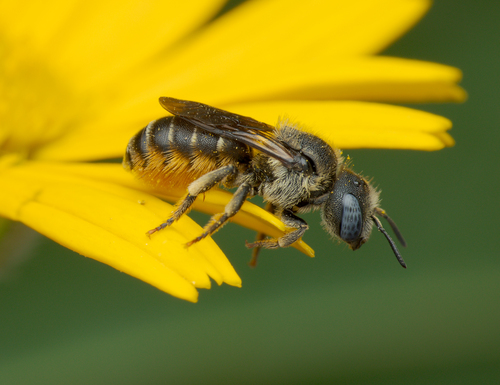
Osmia spinulosa (Kirby, 1802) is a bee that reaches 7–8 mm in total length. In males, the 15th tergite has terminal ligaments, and the 7th tergite has a single thorn; field identification requires prior experience. In females, tergites 1 through 6 have terminal ligaments, each side of the scutellum bears a pointed thorn, and the tibial spur is red.
This species ranges from the Spanish Pyrenees foothills in Girona across Europe, Asia Minor, the Caucasus, and western Central Asia to the Central Siberian mountains of Tomsk, Kemerovo, and the Altai Republic. To the north, it reaches South Wales, Central England, 60°N in Norway and Sweden within Scandinavia, and the Russian regions of Kirov and Perm. To the south, it extends to Sicily and southern Bulgaria. In Germany, it has been recorded in all federal states except Schleswig-Holstein; it is widespread across the country but only occurs sporadically in the North German lowlands, and is moderately frequent especially in hill country and limestone low mountain ranges. It has been found at elevations up to 2000 m in the Alps. It has been reported from every Austrian state, and recorded from the Swiss cantons of Geneva, Neuchâtel, Bern, Basel, Schaffhausen, Valais, Graubünden and St. Gallen, with historical records from the canton of Vaud.
Its main habitat includes settlements, centered on dry, warm habitats on calcareous subsoil. It can be found on inland dunes, drifting sand fields, weathering heaps, disused quarries, fallow sheep pastures (juniper heaths), warm forest fringes, structurally rich old fallow vineyards, and uneven meadows; it rarely occurs in dry and warm ruderal areas.
Osmia spinulosa is univoltine, meaning it produces one generation per year. Adults fly from early June to mid-August, and the species overwinters as a resting larva inside a snail shell. It is an oligolectic species that specializes on plants in the family Asteraceae, with no clear preference for any single species. Documented pollen sources include Anthemis tinctoria, Anthemis arvensis, Inula hirta, Inula salicina, Inula ensifolia, Buphthalmum salicifolium, Pulicaria dysenterica, Aster amellus, Senecio jacobaea, Echinops spaerocephalus, Cirsium vulgare, Cirsium arvense, Carduus crisous, Cichorium intybus, Picris hieracioides, Leontodon autumnalis, Hieracium pilosella, Telekia speciosa, and Calendula officinalis (the latter two are used at the Munich Botanical Garden). Buphthalmum is a particularly important pollen source in limestone mountains. Females do not consistently visit the same flower species; during a single foraging flight, they regularly visit up to four different Asteraceae species, for example a combination of Hieracium, Centaurea, Anthemis, and Echinops. These host plants also serve as nectar sources.
This bee nests in empty small snail shells, including shells of Helicella itala, Helicella obvia, Cepaea nemoralis, Zebrina detrita, and Futicicola fruticum; one nest has been found in a small shell of Helix pomatia. It uses chewed plant parts called plant mortar collected from the edges of Sanguisorba minor and Potentilla reptans leaves as building material, which corrects a prior misinterpretation that the bee used hare or sheep dung. Unlike other bee species that nest in snail shells, Osmia spinulosa does not cover the outer surface of the snail shell with plant mortar.
Multiple cuckoo and brood parasites are known to target Osmia spinulosa, including the cuckoo bee Stelis odontopyga, plus Stelis phaeoptera, Chrysura cuprea, Chrysura dichroa, Chrysura trimaculata, Melittobia acasta, Pteromalus apum, Pteromalus venustus, and the brood parasite Anthrax aethiops.