About Osmia cornuta (Latreille, 1805)
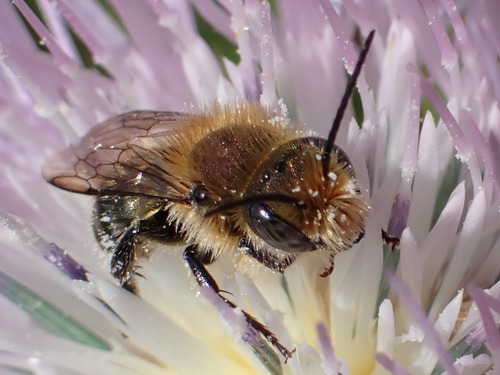
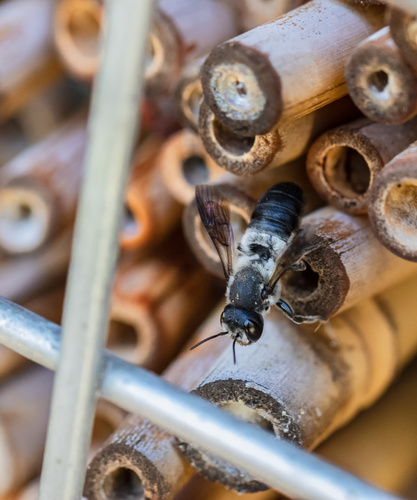
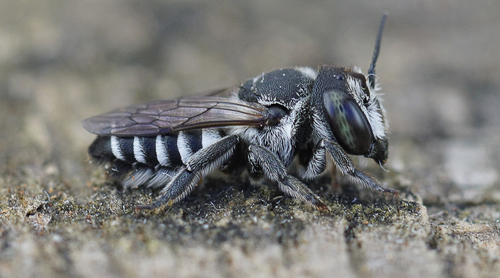
Osmia cornuta (Latreille, 1805) adults measure 10–15 mm in length. Males have conspicuously hairy faces, while females are easily identifiable by their black hair covering the head and thorax, rust-red hairy abdomen, and horned head shield. Three subspecies are recognized: ssp. divergens (Friese, 1920), found from Iran to Central Asia; ssp. neoregaena (Mavromoustakis, 1938), found on the Aegean Islands and Cyprus; and ssp. quasirufa (Peters, 1978), found from the Turkish Aegean coast to the Caucasus, north-west Iran, and in an isolated population in Egypt.
The native range of Osmia cornuta includes North Africa (Algeria, Tunisia, Egypt), and Eurasia stretching from Portugal through southern and central Europe, Asia Minor, and the Caucasus, to Southeast Kazakhstan. To the north, it reaches the North German Plain, Central Poland, Northern Ukraine, and Voronezh; to the south, it reaches Sicily, Crete, Syria, and Northern Iran. A reported record from Primorye is based on an error. The species was introduced to the United States for pollination, but no viable wild populations have been reported there. In Germany, it has been recorded from all federal states except Schleswig-Holstein, and is more common in the south than the north. In Austria, it is also recorded from all states except Schleswig-Holstein. It occurs mainly in warmer locations below 500 m elevation, and very occasionally at higher elevations, such as 728 m in Freudenstadt in the Black Forest. Increasingly, the species is being moved into areas outside its natural native range through commercial trade in its cocoons. In Switzerland, there is no confirmed evidence of the species from the main Alpine ridge or the north side of the Alps; it only occurred historically in the Engadin, but has recent records from almost all other parts of the country. The first confirmed record of this bee in Great Britain was in 2017.
Osmia cornuta requires an early, mild spring, so it occurs predominantly in human settlement areas, where the microclimate and rich supply of early-blooming herbs and trees match its needs. It is likely the most characteristic synanthropic bee species in southwest Germany, found even in the centers of large cities such as Stuttgart, Karlsruhe, and Freiburg, where it forages around commercially sold primroses and hyacinths. Within human settlements, the species almost exclusively chooses large structures, especially house walls, for nesting. Outside built-up areas, it only colonizes sun-exposed loess and clay walls in warm locations. This nesting preference, paired with observations of nesting site searching behavior, leads to the conclusion that the species' original natural nesting sites were steep walls on river banks, where it nested in the abandoned brood cells of Anthophora plumipes. The species occurs from lowland to montane elevations.
This species has one generation per year; adults are on wing from February or March to May or June. Males often emerge as early as mid-March, typically when Scilla begins to bloom, which is earlier than the emergence of Osmia bicornis. Females are active in the morning at temperatures around 10 °C, and their main nesting activity falls between mid-March and early May; in warmer years this shifts to early March to mid-April. Across average years, nesting activity starts in mid-April, reaching a peak at the end of April or the beginning of May. The species overwinters as a fully developed adult inside a cocoon.
Osmia cornuta is extremely polylectic, meaning it collects pollen from a wide range of plant species. Pollen use from 14 plant families has been confirmed: Aceraceae, Aquifoliaceae, Asparagaceae, Asteraceae, Berberidaceae, Brassicaceae, Fabaceae, Fagaceae, Liliaceae, Papaveraceae, Primulaceae, Ranunculaceae, Rosaceae, and Salicaceae. Confirmed pollen sources include Ilex aquifolium, Scilla siberica, Muscari armeniacum, Taraxacum officinale, Epimedium pinnatum, Brassica napus, Trifolium pratense, Trifolium repens, Quercus spec., Tulipa gesneriana, Corydalis cava, Corydalis solida, Corydalis lutea, Primula elatior, Ranunculus acris, Ranunculus repens, Prunus spinosa, Prunus armeniaca, Prunus cerasus, Prunus cerasifera, Pyrus communis, Malus domestica, Crataegus monogyna, Salix caprea, Salix purpurea, Acer platanoides, Acer pseudoplatanus, and Acer campestre. Females usually consistently return to the same pollen source if high-density flowering plants grow near their nesting areas. In pollen loads and brood cells from southern Germany, Prunus, Salix, and Acer make up the highest proportions of pollen; in France, Prunus predominates. In Spain, researchers also found Prunus to be the dominant pollen type, but females in apple plantations mainly collected Malus pollen when it was easily accessible. One study found pollen loads contain mixtures of pollen from 2 to 6 plant families.
Unlike honey bees, Osmia cornuta lacks pollen baskets on its hind tibiae, does not produce honey, and does not live in colonies in hives. It uses pollen and nectar to stock its completed nests. It nests in pre-existing cavities of various shapes and sizes, including cracks in walls, holes in plaster, drainage pipes, cracks in window frames, recesses in stones, and old abandoned nests of Anthophora plumipes, Anthophora fulvitarsis, and Delta unguiculata. It will also readily use artificial nesting aids such as holes drilled in wood or cut bamboo cane, preferring an internal diameter of 8–9 mm and a length of 20–25 cm, when these aids are attached directly to a house wall or other large surfaces. Nests are mostly linear structures holding up to 12 brood cells, though brood cells may occasionally be arranged irregularly in larger cavities. Osmia cornuta prefers to use moist earth or loam collected from the edges of water sources as nesting building material. When surface ground is very dry, many females will gather at the same site to search for ground cracks or dig holes several centimeters deep to reach moist building material. The nesting mortar is mixed with the bee's saliva.
Osmia cornuta hosts several brood parasites. No cuckoo bee parasites have been observed so far. Known brood parasites include the wasps Chrysis ignita, Chrysura simplex, Leucospis dorsigera, Melittobia acasta, Monodontomerus aeneus, and Monodontomerus obscurus; the flies Anthrax anthrax and Cacoxenus indagator; the beetle Sitaris muralis; and the mite Chaetodactylus osmiae. Some countries use Osmia cornuta as a pollinator for almond and pome fruit plantations.