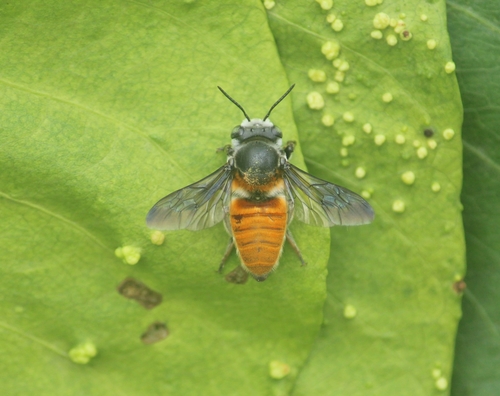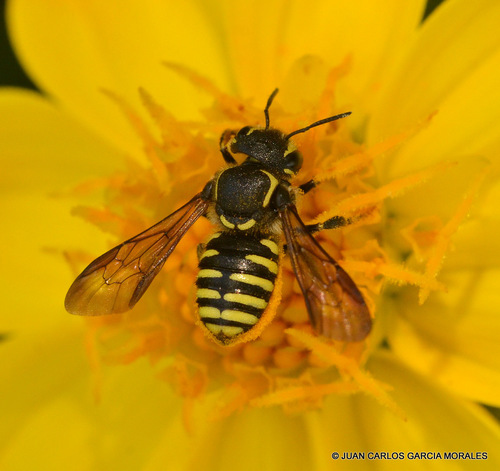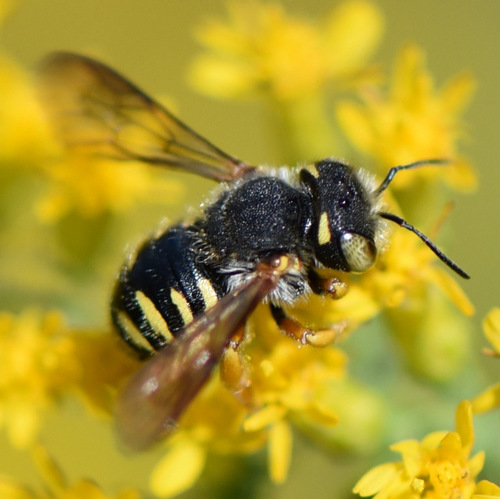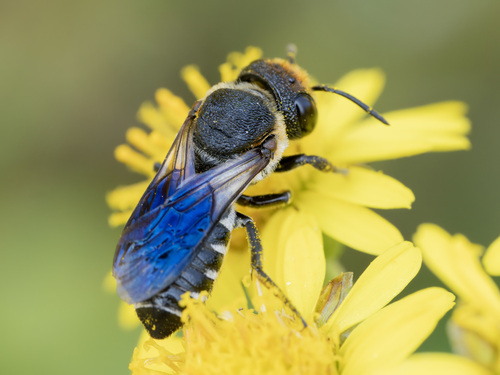
About Osmia bicornis (Linnaeus, 1758)
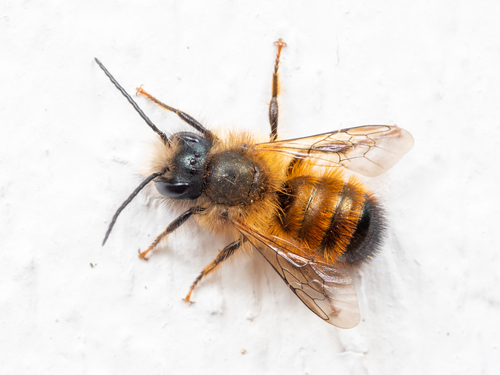
Description and identification: Osmia bicornis is roughly the same body size as a honeybee. This species exhibits sexual dimorphism, with females larger than males. This size difference occurs because female larvae are provided with and consume more pollen. In O. bicornis, body size decreases as the temperature inside brood cells rises. At temperatures above 25 °C, body growth can be severely cut short, resulting in small adult body size or death. Males and females can also be told apart by antenna length: males have one extra antenna segment, a trait seen in almost all Hymenoptera. Distribution and habitat: O. bicornis has been recorded in England, southern Scotland (and may also occur in northern Scotland), Wales, Ireland, mainland Europe, Sweden, Norway, North Africa, Georgia, Turkey, and Iran. Out of the 11 Osmia species identified in England, O. bicornis is both the largest and the most common. O. bicornis uses a wide range of nesting sites in natural environments and in human-built structures. Known nesting locations include key holes, empty snail shells, plant stems, and empty beetle hollows. It specifically nests in old shells of three snail species: Helix nemoralis, Helix hortensis, and Helix pomatia, as well as in the abandoned nests of Anthophora bee species. Additional nesting sites used by these bees are sandy banks, decaying trees (such as willows) growing in clay soil, old-mortared walls, holes in flint stones, garden shed fifes, and holes and cracks in window frames. The maximum foraging distance for O. bicornis is around 600 meters. However, when there is high plant density near nests, bees typically forage closer to the nest and spend less time foraging.