About Osmanthus fragrans Lour.
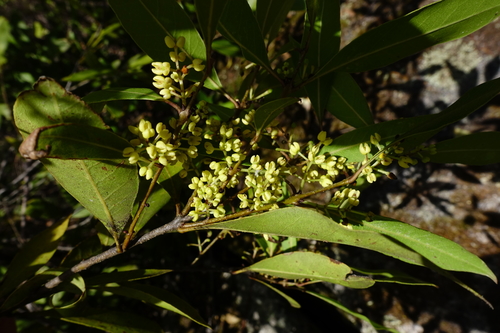
Osmanthus fragrans (literally "fragrant osmanthus") is a flowering plant species belonging to the Oleaceae family. Its common English names include sweet osmanthus, sweet olive, tea olive, and fragrant olive. This species is native to Assam, Cambodia, China, the Himalayas, Hainan, Japan, Myanmar, Taiwan, Nepal, Thailand, and Vietnam; within China, it grows in the provinces of Guizhou, Sichuan, Hainan, and Yunnan. It is the official city flower of three Chinese cities: Hangzhou in Zhejiang, Suzhou in Jiangsu, and Guilin in Guangxi. In Japan, it holds the designation of city tree for Kitanagoya (Aichi Prefecture), Kashima (Saga Prefecture), and Beppu (Ōita Prefecture), and town tree for Yoshitomi (Fukuoka Prefecture).
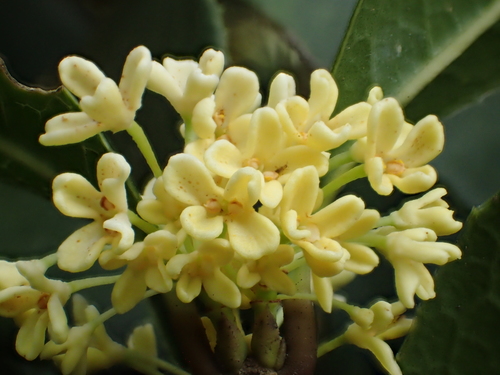
Osmanthus fragrans is widely cultivated as an ornamental plant in gardens across East Asia, Europe, North America, Australia, and other regions around the world. It is grown for its pleasantly fragrant flowers, which have a scent similar to ripe peaches or apricots. Many cultivars have been developed for garden planting, with flowers in a range of colors; one example is Osmanthus fragrans 'Yanhua', which has variegated foliage and orange blooms. In Japan, the white-flowered and orange-flowered subspecies are separately named ginmokusei (literally "silver osmanthus") and kinmokusei (literally "gold osmanthus"), respectively.
In traditional Chinese medicine, osmanthus tea is an herbal tea that has been used to treat irregular menstruation. In vitro laboratory tests have found that extract from dried Osmanthus fragrans flowers has neuroprotective, free-radical scavenging, and antioxidative effects.