About Oryctes rhinoceros (Linnaeus, 1758)
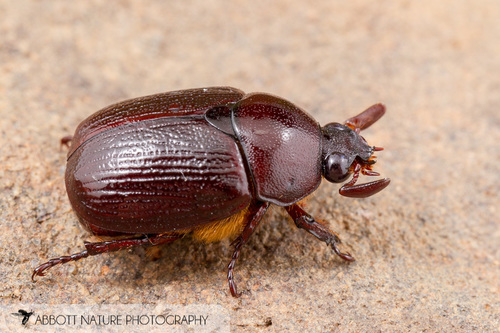
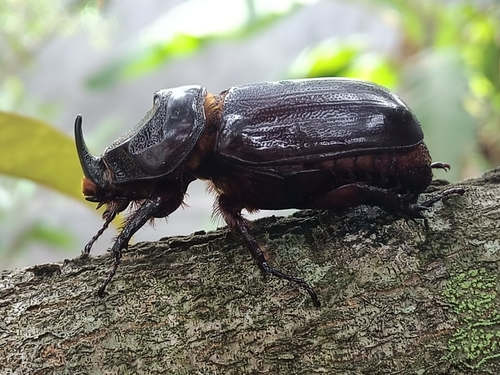
Oryctes rhinoceros, the coconut rhinoceros beetle, is a large dynastid beetle that measures 35–50 mm in length and ranges in color from dark brown to black. The head bears a horn that is more prominent in males and in larger specimens. The pronotum has a large central depression with two humps at its hind margin, and the tibia of the foreleg has three large teeth. Males can be reliably distinguished from females by the tip of the abdomen: in males this tip is rounded, shiny, and hairless, while in females the tip is more pointed and densely covered with hair. Eggs are white and approximately 3 mm in diameter. Larvae take the typical C-shaped white grub form common to scarab beetles. The three larval stages can be differentiated by the size of the head capsule: first instar larvae have a head capsule around 2.5–3 mm, second instar 5–6 mm, and third instar 10–11 mm. The native distribution of this beetle spans most of tropical Asia, extending from India and the Maldives in the west eastward to Myanmar, Thailand, Malaysia, Vietnam, most of Indonesia, the Philippines, Taiwan, and southern China. Human activity has accidentally introduced the species to many tropical Pacific islands, beginning with Samoa in 1909, when larvae arrived in soil accompanying rubber seedlings from Ceylon (now Sri Lanka). From Samoa, the coconut rhinoceros beetle spread to many other parts of the Pacific. Its range has also expanded to several islands in the Indian Ocean and Western Pacific, including Palau and New Britain; most recently, the beetle has invaded Guam, Hawaii, the Solomon Islands, and Vanuatu. The coconut rhinoceros beetle is nocturnal and only flies during the night. Its primary host is the coconut palm, but it also uses other palms, particularly the economically important African oil palm. Occasional attacks have been reported on a variety of other crops, including banana plants and screw palms. This beetle most commonly breeds in decaying coconut or oil palm trunks. These trunks become suitable for breeding after palms are felled for replanting, or when palms die of old age; dead standing palms are the most preferred breeding sites. Other known breeding sites include sawdust heaps around sawmills, garden compost heaps, rubber tree stumps, and other decaying organic matter such as heaps of cocoa (cacao) pods. The breeding substrate must reach a specific degree of decay before females will accept it for egg-laying. Typically, females arrive first at a decaying coconut trunk to breed, and begin preparing the trunk for egg-laying by breaking wood into small particles suitable for consumption by newly hatched first instar larvae. A male often follows the female to mate, and to help her prepare the breeding site. Females deposit eggs and pack wood particles tightly around each egg. Males often remain in the trunk after mating, breaking down additional wood. Eggs hatch after 1.5–2 weeks. Under favourable conditions, the three larval stages are completed in 1.5–2 weeks for the first instar, 2–3 weeks for the second instar, and 13–17 weeks for the third instar. In total, the combined average duration of the egg stage and all three larval stages is around 22 weeks, or 5 months, under favourable conditions. However, larval development can be significantly delayed by unsuitable conditions such as low temperatures or a suboptimal breeding substrate. Young adults emerge from pupae after around three weeks. They remain at the breeding site for an additional three to four weeks, until their cuticle hardens and their flight muscles and reproductive organs are fully developed. They then leave the breeding site and fly to a nearby coconut palm, where they feed and mate. Breeding begins after the first feeding, only two to three weeks after young adults emerge from the breeding site. Under favourable conditions, the total duration of one full generation, from egg to new egg, adds up to approximately seven months. Adult beetles can live up to six months; during this lifespan they attack palm trees, mate, and lay eggs multiple times. Over her lifetime, a single female can lay up to 150 eggs, with a typical average total of 90–100 eggs per female.