About Oryctes nasicornis (Linnaeus, 1758)
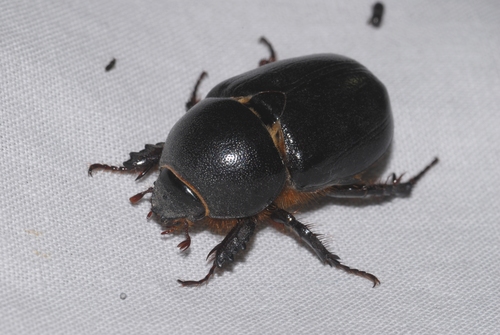
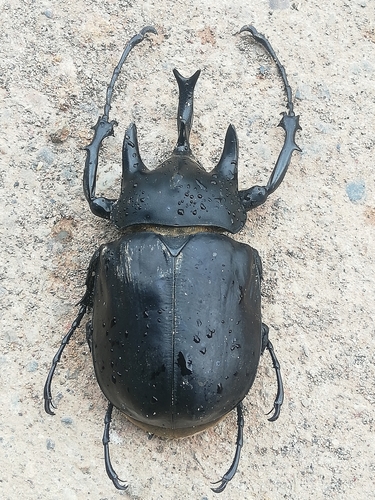
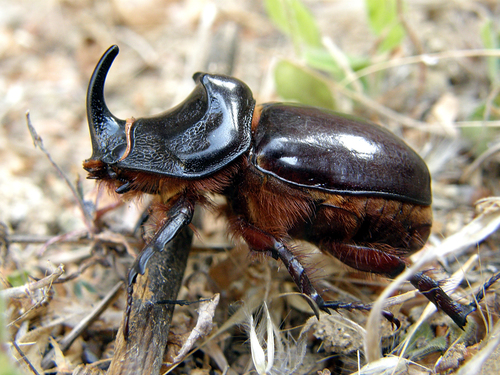
Oryctes nasicornis, one of the largest beetles found in Europe, reaches a body length of 20–42 millimetres (3⁄4–1+3⁄4 inches), with a maximum recorded length of 47 mm (1+7⁄8 in). Its elytra are reddish brown with a glazed appearance, while the head and pronotum are slightly darker. The underside of the body and the legs are covered in long red hair. This species is sexually dimorphic: males have a long curved horn on the top of the head, which gives the species its common name, while females have no horns. Oryctes nasicornis inhabits the Palaearctic region, excluding the British Isles. It is the only member of the Dynastinae family found in Northern Europe, and is widespread across the Mediterranean basin, extending as far as Pakistan, the Near East, and North Africa. Rhinoceros beetles depend on wood to complete their life cycle; large larvae are found in rotting wood stumps and in areas around sawdust. At the edges of its distribution range, the species is often associated with sawmills and horse racing tracks. Larvae develop within decaying plant material, feeding on generally non-resinous woody debris in a xylophagous diet. Fully grown larvae reach a length of 60–100 mm (2+1⁄4–4 in). Larval development takes 2 to 4 years, and the final adult size is influenced by the quality and abundance of food available during the larval stage. The mammoth wasp Megascolia maculata acts as a parasitoid of Oryctes nasicornis larvae: the female wasp lays a single egg inside the beetle larva, and once the egg hatches, the young wasp larva feeds on the beetle larva host. Adult beetles emerge between late March and May, and live for a few months until autumn. Adults are most commonly encountered during June and July, are very active, and fly at dusk and night, where they are attracted to lights. Adult beetles do not feed, and only consume the energy reserves they accumulated during the larval stage.