About Oryctes monoceros (Olivier, 1789)
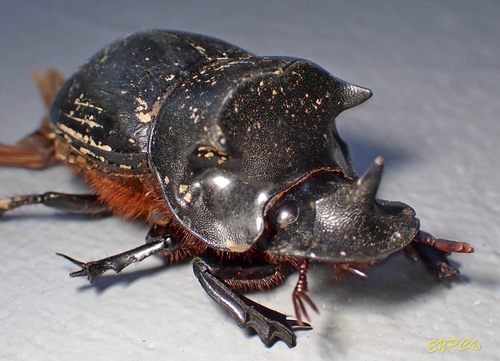
Adult Oryctes monoceros measure around 4 cm in length, and have dark reddish brown to black coloration. On average, males are larger than females. Male horns are moderately long and strongly curved backward, while female horns are very short. O. monoceros is classified in the subgenus Rykanoryctes, which is defined by having three fixed, immovable spikes (prongs) at the end of the hind tibia. It can be distinguished from other African species of this subgenus by several traits: the shape of the male pronotum, elytra that are covered with pits but lack longitudinal grooves, two knobs near the middle of the hind margin of the depression on the male pronotum, a broad clypeus with a deep rounded notch, elytra that are longer than their combined width, and a fore tibia with four teeth. The size, life cycle, host plants, and status as an agricultural pest of O. monoceros are similar to those of Oryctes rhinoceros from the Asia/Pacific region. These similarities make the morphological differences between the two species a topic of interest. Additionally, there is a small overlap in the distributions of both species, for example on Réunion. O. rhinoceros is in the subgenus Rykanes and has only two fixed spikes at the tip of the hind tibia, while O. monoceros (subgenus Rykanoryctes) has three. Male O. monoceros also have shorter, more rearward-curved horns than male O. rhinoceros, though both species show wide variation in horn length. The type locality of Oryctes monoceros is Senegal, which marks the northern and western limit of the species' distribution. Its range extends south to South Africa, and covers most of sub-Saharan Africa. It is especially common in tropical western Africa, including Ivory Coast, Ghana, Togo, Benin, and Nigeria. In central and eastern Africa, the northern edge of its range reaches the southern parts of Chad and Ethiopia. O. monoceros is also frequently reported from the coastal areas of eastern Africa, such as those of Kenya, Tanzania, Mozambique, and South Africa. It is additionally found in Madagascar and eastern Indian Ocean islands including the Seychelles and Réunion. Ecological studies indicate that coastal areas of sub-Saharan Africa have the highest environmental suitability for O. monoceros. The biology of Oryctes monoceros is very similar to that of Oryctes rhinoceros from Asia and the Pacific. The main host plants of both species are coconut and oil palms, and the beetles can cause serious damage, particularly to young palms. Adult Oryctes monoceros attack these palms shortly after nightfall, boring into the center of the palm crown starting from the leaf axil of one of the younger fronds. Inside the palm crown, they feed on still-undeveloped fronds. When damaged fronds unfurl, they show characteristic triangular cuts, or portions of the frond break off and wilt. Like many other species in the genus Oryctes, Oryctes monoceros breeds in decaying organic matter. It prefers decaying coconut and oil palm trunks, but other decaying materials such as felled forest tree wood or compost heaps are also suitable for larval development. Immature stages include the egg stage, three larval stages, and the pupal stage. Development across all immature stages takes approximately 4–5 months, and the adult stage lasts an additional 2 months. O. monoceros population levels are primarily determined by the abundance and suitability of available breeding sites. Other factors, such as the presence of parasites, predators, and diseases, appear to be less important.