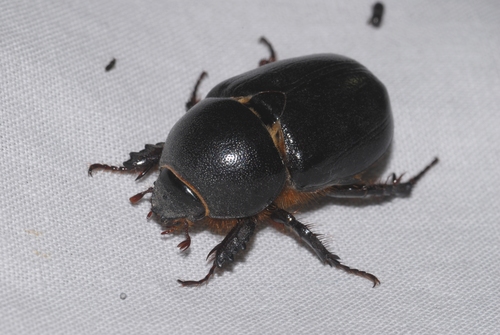
About Oryctes boas (Fabricius, 1775)
Oryctes boas (Fabricius, 1775) is a small to medium-sized species within the genus Oryctes. Adult body length typically ranges from 30 to 40 mm; examination of 711 specimens by Sebö Endrödi found an overall size range of 27 to 46 mm. Adult beetles are glossy and dark reddish brown. Males have a very long horn with a backward-curved tip; the middle of the horn may be slightly thickened, and individuals from eastern Africa occasionally have a small backward-pointing tooth on the inner side of the horn. Males also have a characteristic pronotum shape: it holds a very large central depression, with two well-separated pointed teeth along the depression’s hind margin. The anterior section of the male pronotum, adjacent to the head, is covered in long, dense hair. Females have a very short horn, a small round pronotum depression, and usually two closely spaced knobs at the depression’s hind margin. This species has a broad clypeus with a deep central indentation and pointed outer corners. Its elytra are longer than their combined total width, at an approximate ratio of 27:21.5. Elytra surfaces bear pits, which are more numerous and deeper in males than in females. Like the related species Oryctes monoceros, Oryctes boas is common across Africa. The two species share a similar distribution range and are both known pests of coconut palms. Males of the two species are easily distinguished: O. boas males have much longer horns than O. monoceros males. On average, O. boas is also smaller than O. monoceros and has a more solid body build. Both species belong to the subgenus Rykanoryctes, which is defined by having three fixed, immovable spikes at the tip of the hind tibiae. The type locality given by Fabricius for Oryctes boas is Sierra Leone. Two synonymized species were originally described from other regions: Geotrupes ferrugineus from South Africa, and Oryctes senegalensis from Senegal, inferred from the species’ name and the title of its original description. In his taxonomic review of Oryctes species, Sebö Endrödi recorded localities for over 700 examined O. boas specimens held in museums and collections. These specimens originated from 27 sub-Saharan African countries: Angola, Benin, Burundi, Cameroon, Chad, DR Congo, Eritrea, Ethiopia, Ghana, Guinea, Guinea-Bissau, Ivory Coast, Kenya, Lesotho, Liberia, Madagascar, Namibia, Niger, Nigeria, Rwanda, Senegal, South Africa, “Sudan” (the recorded location “Mossi” refers to the Mossi Kingdoms, which is now Burkina Faso, formerly part of French Sudan), Uganda, Tanzania, Togo and Zimbabwe. Specimens were also collected from Yemen in the Near East. These records and other sources confirm that O. boas occurs across almost all of sub-Saharan Africa, with the most frequent records coming from southeastern regions between Tanzania and eastern South Africa, as well as Madagascar. Oryctes boas has not become established outside its native African range, but it is considered a quarantine concern and has been assessed to have invasive potential in China. Like many other Oryctes species, Oryctes boas is a reported pest of coconut palms. Adults bore through the axil of a palm frond into the center of the palm crown (the palm heart, where young fronds develop) and feed on the undeveloped fronds. This damage reduces the palm’s growth and nut production, and can eventually kill the tree; young palms are especially vulnerable to attack. Coconut palm damage from this species has been reported mainly from West Africa, and from some eastern African countries such as Tanzania. In West Africa, O. boas is usually less abundant and less destructive than Oryctes monoceros, the region’s main coconut pest. In addition to its status as a palm pest, Oryctes boas larvae are used as a food source in some countries. The main breeding sites for Oryctes boas are compost heaps, where females lay eggs and immature stages develop. Laboratory rearing data shows the egg stage and first larval stage each last between 7 and 10 days. The second larval stage lasts around two weeks, and the third larval stage (including the prepupal stage) lasts around 11 weeks. The pupal stage lasts another two weeks, bringing the total development time for all immature stages to approximately 18 weeks.