About Ortygornis pondicerianus (J.F.Gmelin, 1789)
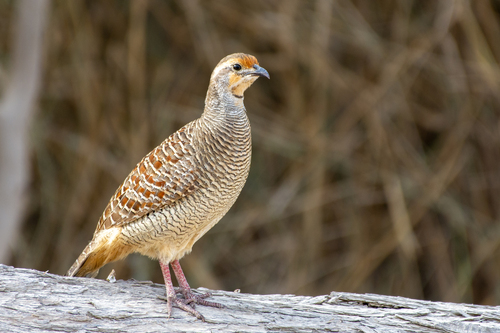
Ortygornis pondicerianus, the grey francolin, is a medium-sized francolin bird. Males average 29 to 34 cm (11.6 to 13.4 in) in length and weigh 260 to 340 g (9 to 12 oz), while females average 26 to 30 cm (10.2 to 11.9 in) in length and weigh 200 to 310 g (7 to 11 oz). The entire body of this francolin is barred. It has a pale face, with a thin black border along its pale throat. The only species similar in appearance is the painted francolin, which can be distinguished by its rufous vent. Males may have up to two spurs on the legs, while females usually lack leg spurs. Three main subspecies are recognized, with an additional populations of uncertain status. The palest subspecies, O. p. mecranensis, occurs in arid regions of north-western India, eastern Pakistan, and southern Iran. O. p. interpositus is darker than mecranensis, with intermediate plumage, and is found in northern India. The nominate subspecies, found on the southern peninsula of India, has darker rufous coloration on the throat and supercilium, and is an overall richer brown. Populations of this species in Sri Lanka are sometimes treated as the separate subspecies O. p. ceylonensis, or considered part of the nominate subspecies. Grey francolins are weak fliers, so they only fly short distances, and typically escape into undergrowth after just a few short bursts of flight. In flight, they show a chestnut tail and dark primaries. This species forages on bare ground or low grass-covered ground in scrub and open country. In India, it is rarely found above 500 m above sea level; in Pakistan, it is rarely found above 1200 m above sea level. Its native distribution extends south of the Himalayan foothills, west to the Indus Valley and east to Bengal, and it is also native to north-western Sri Lanka. Introduced populations have been established on the Andaman and Chagos Islands, as well as in Nevada and Hawaii in the United States, alongside several other francolin species. Loud calls of grey francolins are commonly heard in the early morning, and pairs will sometimes call in a duet. Female calls consist of a repeated tee...tee...tee, and sometimes a repeated kila..kila..kila. The challenge call kateela..kateela..kateela is performed as a duet. Grey francolins are usually observed in small groups. The main breeding season for this species runs from April to September. The nest is most often a hidden scrape dug into the ground, though it may sometimes be built above ground level in a niche in a wall or rock. The typical clutch size is six to eight eggs, but larger clutches have been recorded, which may be the result of intraspecific brood parasitism. Grey francolins feed on seeds and grains, as well as insects, particularly termites and beetles from the families Tenebrionidae and Carabidae. They may occasionally prey on larger animals such as snakes. They roost communally in low thorny trees. Several species of feather mites, helminths, and blood parasites have been recorded from this species.