About Orthetrum cancellatum (Linnaeus, 1758)
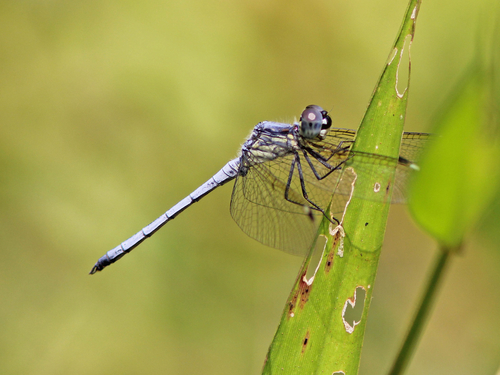
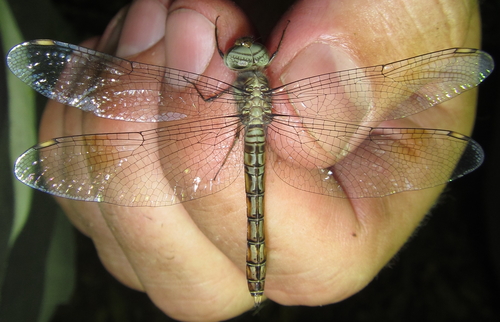
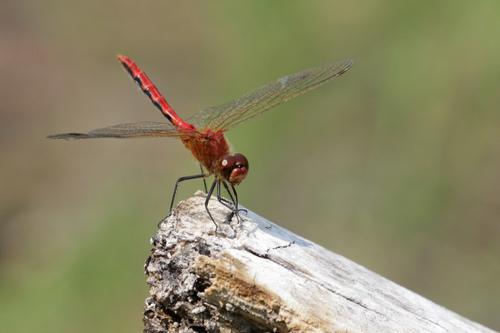
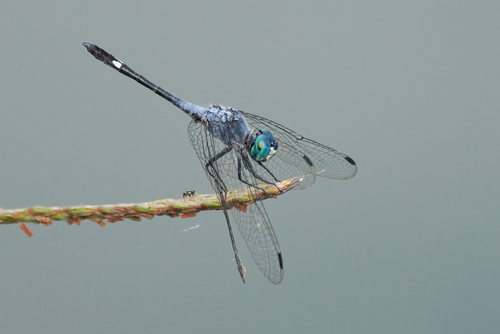
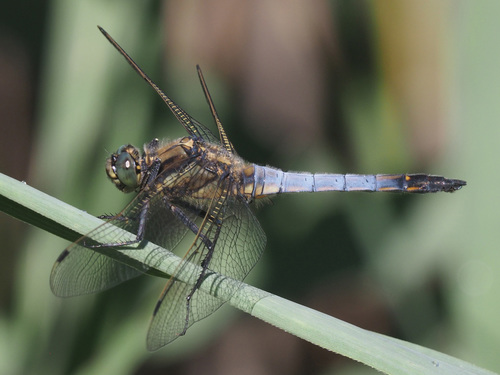
Orthetrum cancellatum (Linnaeus, 1758), commonly called the black-tailed skimmer, is a fairly large dragonfly species. Adults measure 47–53 mm in total length, with an abdomen 29–35 mm long and a rear wing 35–41 mm long. It has a relatively broad, flattened abdomen, which is not as broad as the abdomen of chaser species. As adult males age, they develop extensive blue pruinescence on their abdomen, contrasted by yellow lateral patches; the pruinescence darkens toward the rear of the abdomen, turning segments S8-10 black. The middle lobe of the pronotum is large and notched at its center. The thorax is yellow or yellowish-brown, and the eyes are very dark green. There are no dark opaque spots at the base of the hind wings. The pterostigma is dark brown or black, and measures 2–3 mm long on the front wings. Anal appendages are black. Females and immature males are deep yellow, with wavy black lines on the dorsal side of the abdomen. Both sexes have a yellow or black costal vein, the leading edge of the wing. Females retain their base color and markings, though they become quite grayish-brown with age. This species flies swiftly and low, skimming over the water surface. Adults prefer to perch on bare ground and rocks. This species can be confused with the keeled skimmer or the scarce chaser, but it is readily distinguishable in the field from its much more localized congener Orthetrum albistylum. This species is widespread across Europe and Asia. It occurs throughout the European continent, including Mediterranean islands, but is absent from northern Britain and the northern half of Fennoscandia. It is one of the most common dragonfly species in Europe, and is still expanding its range northwards. To the east, its range extends from central Asia to Kashmir, Mongolia, the northern parts of China, and Arunachal Pradesh in India. Documented countries where it is present include Albania, Austria, Azerbaijan, Belarus, Belgium, Bosnia and Herzegovina, Bulgaria, China, Croatia, Cyprus, Czech Republic, Denmark, Estonia, Finland, France (mainland France and Corsica), Georgia, Germany, Greece, Hungary, India, Ireland, Italy, Kazakhstan, Kyrgyzstan, Latvia, Lithuania, Luxembourg, Malta, Moldova, Mongolia, Montenegro, Netherlands, North Macedonia, Norway, Poland, Portugal, Romania, Russia, Serbia, Slovakia, Slovenia, Spain, Sweden, Switzerland, Tajikistan, Turkey (Turkey-in-Europe), Turkmenistan, Ukraine, Uzbekistan, and part of the United Kingdom. The black-tailed skimmer is abundant across its range, and is one of the most commonly observed dragonflies in Europe. It has a stable population with no known major threats. It has expanded its range, aided by the creation of gravel pits that provide the extensive open unvegetated areas the species prefers. It was first recorded in Great Britain in Essex in 1934, and it is currently decreasing rapidly in the Maltese Islands. The black-tailed skimmer inhabits any open water with bare patches along the shore, where patrolling males frequently rest in sunlight. It also lives near slow-flowing waters. It favors lakes, slow rivers, ponds, and sometimes marshy areas, that lack dense riparian vegetation. Females are less bold than males, and are not encountered as regularly.