About Orthemis schmidti Buchholz, 1950
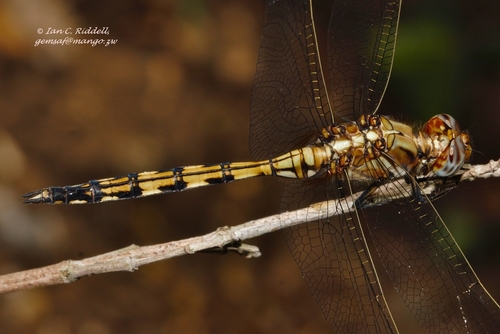
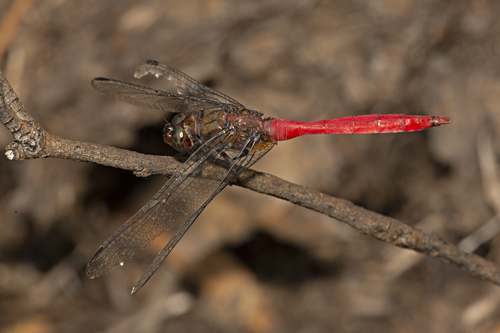
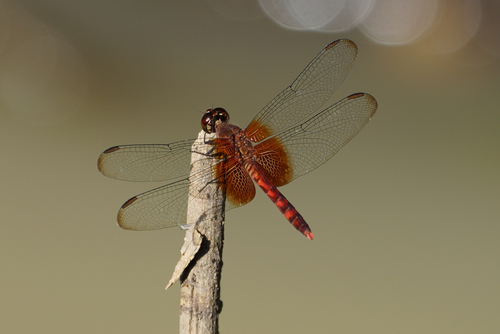
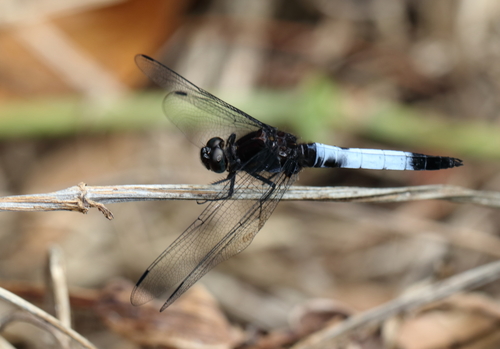
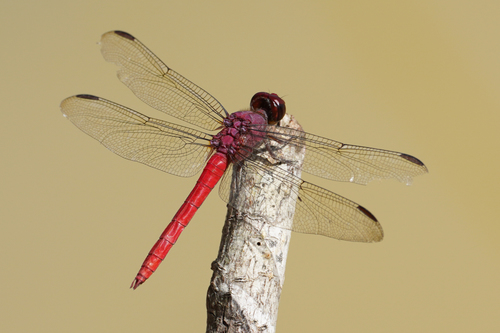
Orthemis schmidti has a distinct reddish-brown forehead at the front of its head. Its face is olive-ocher, edged with a reddish-brown border. The upper lip is reddish-brown with a black margin, while the lower lip has a greenish spot at its center. This species shows varied coloration across its body segments. The prothorax, the first body segment directly behind the head, is reddish-brown. The middle body segment, the thorax, is dark reddish-brown with a faint purplish-black sheen. Thin yellow lines and additional yellow spots mark the sides of the thorax. The front legs and their basal segments (hips) are dark ocher, and the hind legs are dark brownish-red. The tarsi (feet) are solid black. The third segment of the leg bears small pointed teeth that increase in size toward the lower end, and a small spine is present at the tip. The abdomen is robust, tapering gradually toward its tip. The dorsal surface of the abdomen is reddish-brown; the sides of the first and second abdominal segments are yellowish, and a thin yellow stripe runs along the sides of some abdominal segments. The ventral surface of the abdomen is yellowish, marked with a long, interrupted dark brown stripe running down its center, with brown sclerites at the abdominal tip. The wings are transparent, with a distinct brown spot at each wing tip. The wing veins are black and closely spaced. In one pair of wings there is one unique radial sector cell, and two in the other pair; one of the specialized wing veins forms a zigzag shape. The hindwings have rows of small cells along the outer margin that form a curved, irregular loop shape. The original 1950 description of Orthemis schmidti was based on a single specimen collected in Peru. Confirmed recorded observations place the species’ range across northern South America, the Caribbean, and Central America.