About Orphium frutescens (L.) E.Mey.
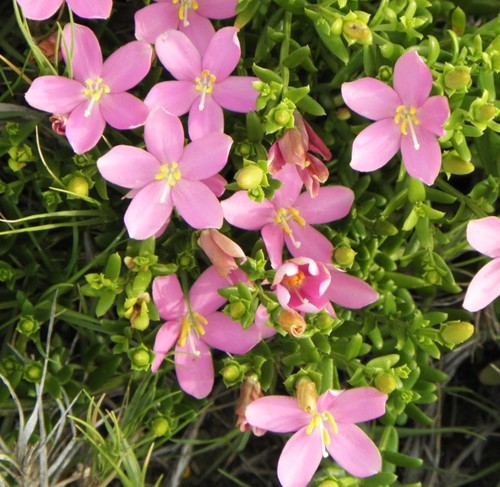
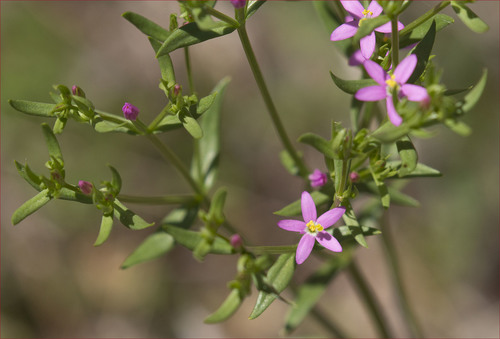
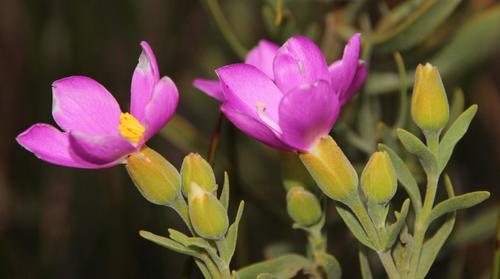
This species is scientifically named Orphium frutescens (L.) E.Mey. The Orphium genus is an erect subshrub with virgate branching. Plants are more or less pubescent, with leafy branches reaching all the way to their apex. Leaves are opposite, sessile, and rather crowded; they are fairly thick, slightly leathery, and shaped bluntly linear to narrowly cuneate. Flowers can be solitary, or borne in loose terminal cyme inflorescences, or in the axils of upper leaves. The calyx has five lobes that fit loosely around the base of the corolla. Its tube is short and bell-shaped, with an annular, finely crenulate disk inside at its base. Calyx lobes are oblong and mucronate, and lack a dorsal keel. The corolla is most often a vibrant candy pink, and rarely white, contrasting with the plant's vivid yellow anthers. The corolla tube is about as long as the calyx, or slightly longer. Petals are oblong to nearly circular, and slightly longer than the corolla tube. Stamens are inserted below the mouth of the corolla tube. Anthers are erect, with a slight spiral twist. The ovary has a single locule with parallel placentation. The stigma is terminal and peltate. The fruit is a capsule that dehisces septicidally. Orphium frutescens grows in the western coastal regions of Cape Province, South Africa. It is most commonly found along the coast, where it tolerates sandy and saline soils, though it can also tolerate clay. It grows best in temperatures ranging from 7 °C (45 °F) to 24 °C (75 °F). It has been cultivated at Kew Gardens in London since the late 18th century. Its flowers only release pollen when they detect the vibrations of South Africa's native carpenter bees. For this reason, when grown outside its native range as an exotic plant, it will not produce seed without manual intervention.