About Orobanche rapum-genistae Thuill.
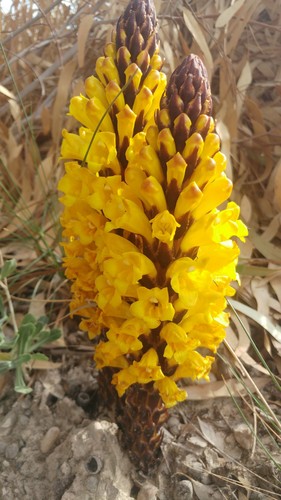
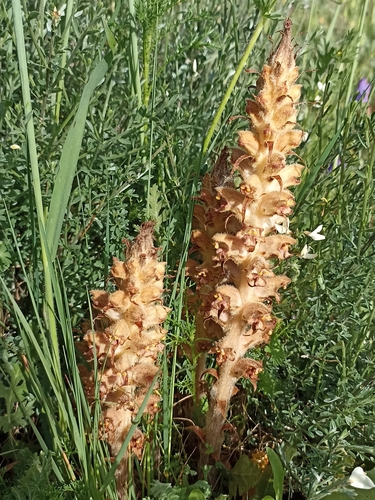
Orobanche rapum-genistae Thuill., commonly called greater broomrape, is a perennial parasitic plant in the broomrape group. Like other broomrapes, it contains no chlorophyll and is fully dependent on host plants for all of its nutrients. This species can reach up to 1 meter (3 feet) in height, and has a downy, honey-brown stem. After flowering, the stem persists as a dark brown dead spike. Its leaves are reduced to small pointed scales that are concentrated near the base of the stem. Each individual flower has a single bract below it that is longer than the flower itself. Flowers have a two-lipped corolla, four stamens, and a style curved downward. The upper lip of the corolla is hooded, while the lower lip has three lobes with the central lobe being the largest. Fruits are egg-shaped and remain enclosed within the dead flowerhead, and the seeds are extremely small. Greater broomrape parasitizes the roots of leguminous shrubs, and only grows in locations where its host plants are present. Its most common hosts are European gorse and common broom, and it occasionally grows on dyer's greenweed. It has a suboceanic southern-temperate distribution, found across Western Europe and North Africa. It is widespread in France, the Netherlands, and Belgium; in Germany it occurs mainly in the west, and in Switzerland it grows in montane and sub-alpine areas. It grows throughout all of Italy, and is also found in Corsica and Algeria. In Britain, it occurs in scattered locations, mostly in Wales, Southwest England, and near the coast in South England. It was in decline during the 18th and early 19th centuries, but has made a recovery in more recent times. It can also be found growing at Great Casterton Road Banks, a Site of Special Scientific Interest in Lincolnshire.