About Orobanche minor Sm.
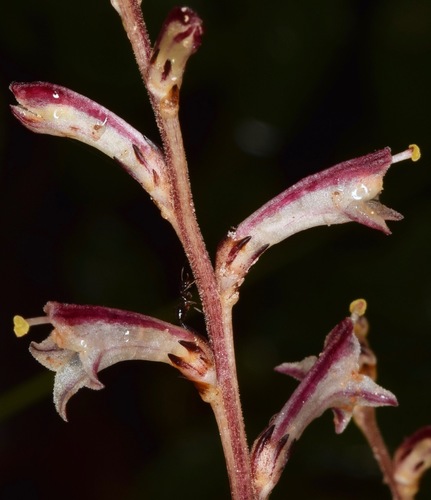
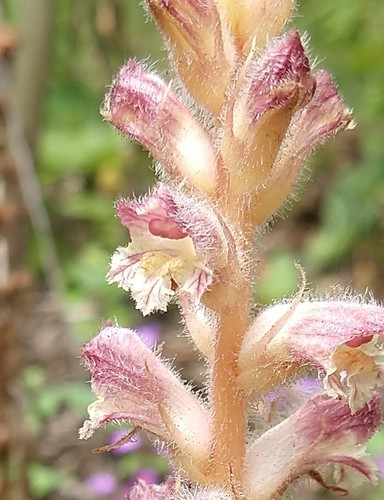
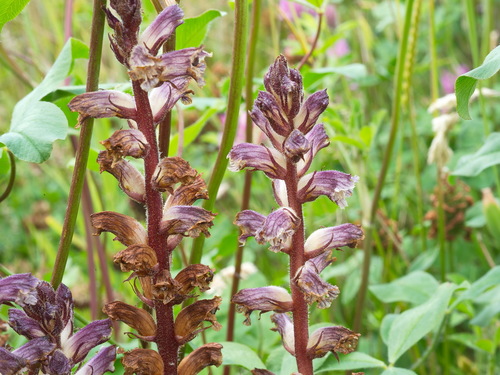
Orobanche minor Sm., commonly known as common broomrape, is a perennial herb that grows up to 0.5 m (1 ft 8 in) tall. Its flowers are hermaphrodite. It can grow in a wide range of soil types including moist light (sandy), medium (loamy), and heavy (clay) soils, and tolerates acid, neutral, and basic pH levels. It grows well in both full sunlight and semi-shade. This species displays extensive color variation, ranging from red-brown and yellow-brown to purple, with yellow specimens also being relatively common. This high variability in size and color makes identification based on these traits unreliable. Orobanche minor is a parasite that infects various species from the pea (Fabaceae) and daisy (Asteraceae) plant families. Although it is widespread, it occurs sporadically, and can occasionally form very large colonies. Its main flowering season runs from May to late August in the northern hemisphere, and from August to January in the southern hemisphere. This species has efficient seed dispersal and is mostly inbreeding. As a result, populations that preferentially parasitize a specific host with distinct ecological preferences can become effectively isolated, and may eventually evolve into distinct taxa. Orobanche minor attaches to its host plants using haustoria, which transfer nutrients from the host to the parasite. Only hemiparasitic Orobanche species have an additional extensive root system; the root system of O. minor is reduced, and its primary function is anchoring the plant. Common broomrape is one of the most widespread species in its genus. It is native to Southern Europe, but has been widely introduced to other regions including the United States. It is the only species of the Orobanche genus found in New Zealand, where it is considered an agricultural pest. In the United Kingdom, it is widely recorded in southern England, is less common in Wales, is rarely recorded in lowland Scotland, and is absent from the Scottish Highlands and outer islands.