About Orobanche hederae Duby
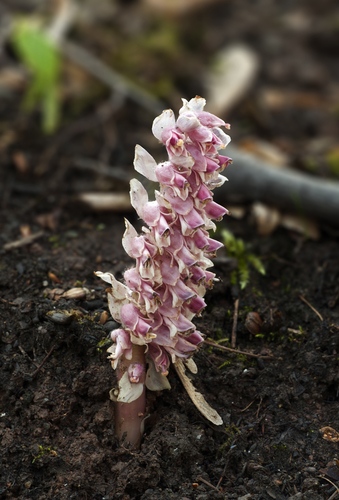
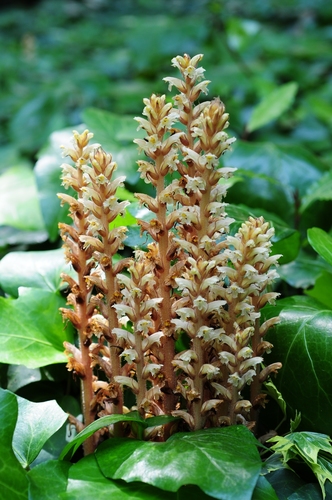
Orobanche hederae Duby, commonly known as ivy broomrape, has yellowish to purplish stems that are usually strongly swollen at the base, measuring 15–60 cm (5.9–23.6 in) tall and 0.3–0.8 cm (0.12–0.31 in) thick. Stems are covered in short, soft glandular hairs. Its leaves are acute, and shaped oblong to lance-like. The calyx (sepals) measures 10–15 mm (0.39–0.59 in), with free segments that are either entire or unequally bifid. Its dull cream to reddish purple corolla (petals) is 10–22 mm (0.39–0.87 in), nearly hairless, and grows with an upright spreading to roughly patent habit. Stamen filaments (stalks of the stamen) are inserted 3–4 mm (0.12–0.16 in) above the base of the corolla; they are usually hairless, but are rarely somewhat hairy near their base. Fruits are 10–12 mm (0.39–0.47 in) capsules, and fruiting spikes of this plant contain thousands of minute seeds.
Ivy broomrape closely resembles the more widely distributed O. minor, and both species can parasitize members of the ivy family. O. hederae is primarily distinguished by its characteristically distally pinched corollas, flowers that extend across most of the stem, long acuminate floral bracts, and a large terminal bud of unopened flowers that gives the spike a pointed tip. The stigma of O. hederae is usually yellow, and its corolla is curved downwards and cream-colored.
This plant’s native distribution matches that of its host, ivy, so it is mainly found in central and Northern Europe, as well as parts of Asia. In the United States, it has been observed growing in a patch of invasive ivy at the University of California, Berkeley, near the life sciences building.
Ivy broomrape primarily propagates by seeds, which are dispersed by wind, but it can also regenerate from small root fragments left in the soil. Like many broomrape species, its seeds can remain dormant but viable for many years. When a seed germinates, its embryo grows out a thin, thread-like filament that spirals through the surrounding soil until it contacts ivy roots. The filament then penetrates the ivy’s xylem tissues, allowing the parasite to receive water, nutrients, and carbohydrates from its host. The connection between parasite and host can be so complete that it is nearly impossible to tell for certain where the host’s epidermis ends and the parasite’s epidermis begins. For a germinated seed to survive, this connection must form within a few days of germination. Only after collecting enough energy from the host will the plant grow a flowering stalk that becomes visible above ground.
Greek physician Dioscorides recorded that this plant, called ὀροβάγχη, can be eaten raw or cooked like asparagus. He also noted that cooking this plant with pulses makes the pulses cook faster. While Dioscorides did not include any medicinal information for this species in his description, Russian and Northern European folklore both describe the plant as highly medicinal. A literature review of traditional Orobanche use notes that while broomrapes were used as food and medicine across many regions of the world, this dual use occurred mainly in China and North America. In Europe, broomrapes were primarily only used as food.