About Ornithostaphylos oppositifolia (Parry) Small
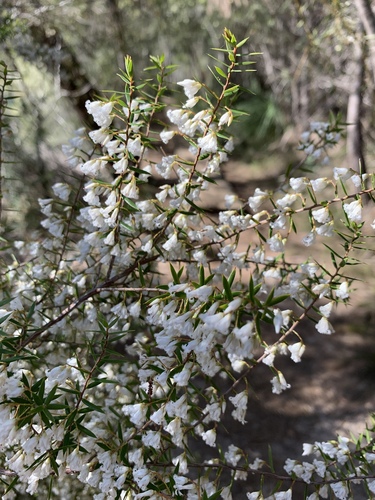
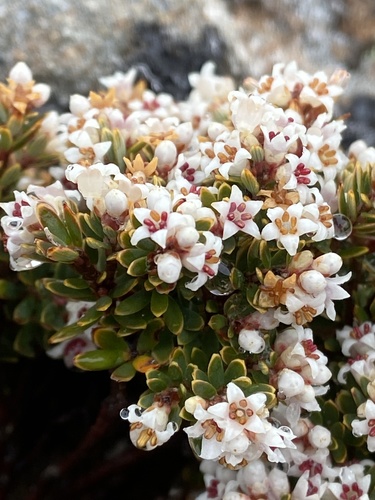
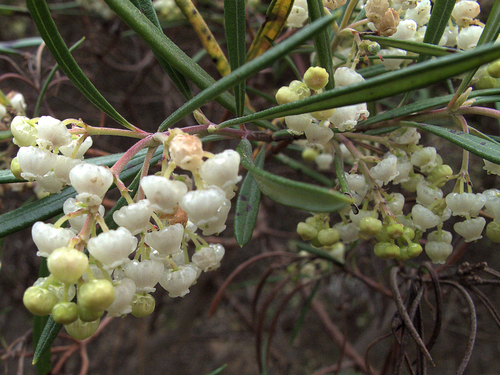
Ornithostaphylos oppositifolia (Parry) Small is a burl-forming species that grows as a branched shrub to small tree, reaching up to 2 meters in height. It has thin, smooth bark that is reddish purple when young, and the bark sometimes peels off. Its erect, rigidly branched stems may be covered in minutely wooly hairs. The evergreen, leathery leaves are arranged opposite each other or in whorls, growing up to 8 centimeters long and 6 millimeters wide. Leaf margins are rolled under; the upper leaf surface is dark green, while the underside is white and hairy. The inflorescence is a panicle holding 10 to 20 flowers, each suspended from a long pedicel. Fused petals form a white, urn-shaped flower, which contains 10 stamens and a 5-chambered ovary. The fruit is a spherical reddish-brown drupe with 5 stones, and each stone holds 2 seeds. This species is distributed across northwestern Baja California, Mexico, and a small area of California in the United States. In Baja California, it occurs from Tijuana south to the southern end of the Sierra de San Pedro Martir. In California, around 100 individuals grow north of the International Border on a single mesa near the Tijuana Hills. This species grows in coastal chaparral, where it can form dense, nearly pure strands. The United States population is threatened by habitat fragmentation caused by road construction, trail development, and Border Patrol activities including brush clearing. Part of the known United States population was transplanted to make space for the border fence, but the long-term survival of these transplants is uncertain. This is a very slow-growing, rare plant. As an attractive small tree, it is well-suited for gardens within its native range, where it is grown as a collector's item or specimen plant. It is hardy to temperatures as low as 12 °F, drought-tolerant, grows well with occasional watering, and prefers well-draining to rocky soil.