About Ornithogalum umbellatum L.
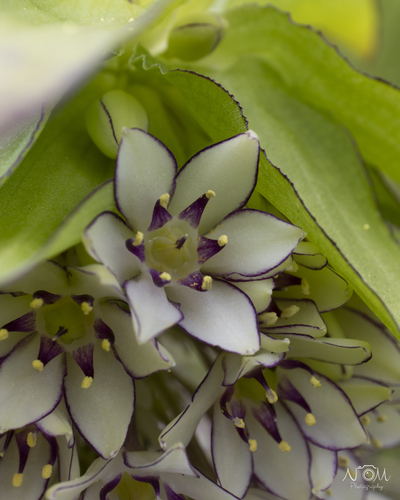
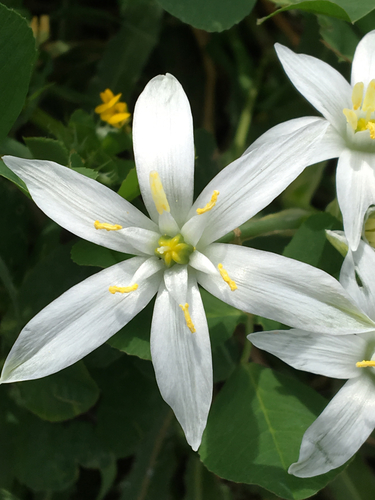
Ornithogalum umbellatum L. is a perennial herbaceous bulbous geophyte that dies back to an underground storage bulb after flowering, and regrows the following year from its bulbs. Its bulbs are usually shallow-rooted, ovoid with a membranous coat, 15–25 mm (1⁄2–1 inch) long and 18–32 mm (3⁄4–1+1⁄4 in) in diameter. Bulbs produce multiple leaf-bearing bulbils that separate quickly but stay close to the parent bulb. The plant first grows 6–10 basal linear leaves that emerge in tufts from the bulb. These leaves are grooved (canaliculate), smooth (glabrous), and have a white to light green linear midrib on the upper surface; they reach up to 30 cm (12 in) long and 8 mm (1⁄4 in) broad. This species is scapose: a glabrous flower stem (scape) emerges later from the leaf tufts, reaches 10–30 cm (4–12 in) tall, and tapers at its tip. The inflorescence holds 6–20 flat star-shaped flowers on 3–3.5 cm (1+1⁄4–1+1⁄2 in) ascending pedicels, with 2.5–3 cm (1–1+1⁄4 in) membranaceous bracts, arranged in an open branching umbrella-shaped (umbel) terminal cluster described as a corymbose raceme. The petal-like, radially symmetric (actinomorphic) perianth is 1.5–2 cm (1⁄2–3⁄4 in) across, made of six lanceolate tepals. Tepals are white with a green stripe on the outer (abaxial) surface, 15 mm (1⁄2 in) long and 5 mm (1⁄4 in) wide. Closed flowers appear green with white margins when viewed from the outside. Flowers are hermaphrodite, containing both male (androecium) and female (gynoecium) reproductive parts. The androecium has six yellow-brown stamens free of the perianth, arranged in two groups of around 5–8 mm (1⁄4–3⁄8 in) each, with simple flattened filaments and 2–4 mm (1⁄16–3⁄16 in) oblong anthers. The gynoecium has one pistil with a superior ovary (located above other floral parts), which is ovoid to obovoid, 3–4 mm (1⁄8–3⁄16 in), and longer than the style that extends above it. The fruit is a three-sided oblong-ovoid capsule with six ribs. Each locule inside the capsule holds many seeds with a black phytomelan seed coat. This species is polyploid, meaning it carries more than two sets of chromosomes. Native to most of Europe, North Africa, and western Asia, Ornithogalum umbellatum was adopted as an ornamental garden plant. It has escaped cultivation and naturalized widely across North America, where it is considered an aggressive noxious weed that is difficult to eradicate, invading lawns, gardens, and no-till agricultural land. In Europe, its native range extends west to Ireland and Portugal, south to Italy, north to parts of France, and east to Turkey and the Levant. It prefers damp habitats, found along rivers and streams, and in lower wet areas of pastures, and is tolerant of both shade and a wide range of soil types. Ornithogalum umbellatum is thermoperiodic, and requires a cold winter to complete its life cycle. It first emerges as leaf tufts in early spring, before flowering (this trait is called proteranthous). Flowering occurs in late spring, from May to June, and leaves fade before blooming. It reproduces via bulbs, which form many offsetting bulbils that can be dispersed by water. Like many temperate bulb plants, it requires a period of cold exposure before spring growth can begin, which prevents growth during winter when intense cold could cause damage. Warmer spring temperatures then trigger regrowth from the bulb. This species spreads aggressively into clumps through these offsets. Flowers are insect-pollinated, but may also be self-fertile, and form seeds in summer (June–July). Seed dispersal plays a relatively minor role in propagation, but is responsible for establishing isolated plants. The plant, especially its bulbs and flowers, contains the cardiac glycosides convallatoxin and convalloside, which are toxic to humans and livestock. Poisoning symptoms include nausea, salivation, vomiting, diarrhea, shortness of breath, as well as pain, burning, and swelling of the lips, tongue, and throat. Prolonged skin contact may cause skin irritation. In cultivation, Ornithogalum umbellatum needs considerable moisture during winter and spring, but can tolerate summer drought. It grows well in woodland gardens, where semi-shade is preferable. It is hardy to UK zone 5 and USDA zones 4–9, and can become invasive. It is produced commercially as an ornamental garden plant. To control its invasive spread, it is best planted in a container or a contained edged area. It can also be grown as an indoor plant. Despite its confirmed toxicity, this plant has been recorded as edible for 2000 years, and has been used in some traditional regional cuisines, such as in Turkey, and traditional medicine, such as in India. In Britain, it has long been covered in herbals for its claimed culinary and medicinal properties. Traditional uses include drying and grinding the bulbs, boiling the bulbs, and baking flowers into bread. Plant essences are sold as patent remedies and for aromatherapy, including as a Bach flower remedy. Medical authorities advise against ingesting any part of this plant.