About Ornithogalum divergens Boreau
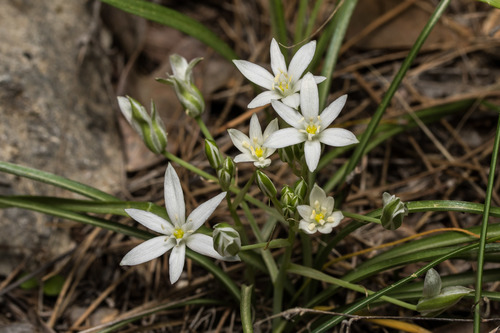
Ornithogalum divergens Boreau is defined by a flattened, oval-shaped bulb surrounded by numerous small bulbils—tiny secondary bulbs that measure 5 to 8 mm in diameter. These bulbils grow on slender stalks 2–8 mm long, and are typically leafless, though they may occasionally produce small, weak leaves. The plant’s main leaves are linear, narrowing gradually towards the tip, smooth, green, and marked with a distinct white stripe running down the center. The plant produces a broad, flat-topped cluster of flowers called a corymb, where the lower flower stalks (pedicels) are exceptionally long, and spread outwards or sometimes bend slightly downwards. Each flower is accompanied by small leafy structures called bracts that are much shorter than the flower stalks beneath them, usually reaching about half the length of the stalks. The flowers themselves are relatively large, and measure 35 to 45 mm across when fully open. Each flower has six elongated, white petals (tepals) that are usually 23 to 28 mm long, and each tepal bears a green stripe on its back. The fruit of O. divergens is a capsule, an oval to slightly rounded seed pod that measures approximately 11–18 mm long and 7–13 mm wide. It has a truncated (flattened) top and is marked by six evenly spaced ribs or ridges. Ornithogalum divergens typically grows in cultivated areas, disturbed habitats, and river valleys, and often favors sandy soils in lowland regions. It is widely distributed across southern Europe, extending eastward into western parts of the Middle East, and reaching northwards to Germany and the Netherlands. Scattered populations also exist in central-western France and Portugal. Historical records of this species from North Africa have not been recently confirmed and remain uncertain.