About Ornithogalum broteroi M.Laínz
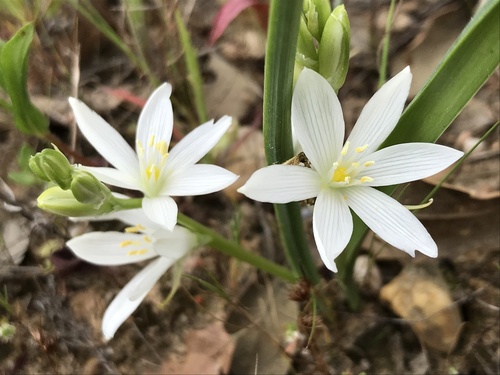
Ornithogalum broteroi M.Laínz shares several key features with the other two members of the Cathissa group: spicate to subspicate (spiked) inflorescences, and corolla segments that do not have conspicuous green stripes on their reverse surface. This species is characterized by scapes that each bear a single leaf; usually a plant produces one scape, but occasionally produces two to three. It grows from a bulb approximately 8–12 mm in diameter, and reaches a total height of 2–10 cm, occasionally growing as tall as 25 cm. Its leaves are 5–15 cm long and 2–6.5 mm wide, lanceolate, and glabrous, with a wide sheath at the base. Each leaf tapers into a cuspidate, cylindrical appendage that is nearly as long as the leaf blade. Its pedicels are short, measuring 1.5–3 mm long, and may reach up to 4 mm; its bracts are much longer, at 8–10 mm long. The inflorescence typically holds 3–5 flowers, sometimes as many as 8. Its perianth segments are 10–16 mm long and white. The ovary, which is rounded at the apex (described as obovate-lanceolate to obtusely truncate apex), is up to two times longer than it is wide, and the style is longer than the ovary. The fruit is an oblong to ovoid capsule. The seeds are 1.6–1.9 mm long, subglobose with one pointed edge, and have a seed coat composed of numerous irregular pieces delimited by ridges. The chromosome number of this species is 2n=34. This species occurs in littoral areas of the Western Iberian Peninsula, ranging from northern Cabo de Finisterre, along the coast of Portugal to Gibraltar. It also extends into some inland areas to the Spanish border, and into northwestern Morocco as far as Marrakech. It grows in open woods and pastures. Its flowering period is from February to March.