About Ornithion inerme Hartlaub, 1853
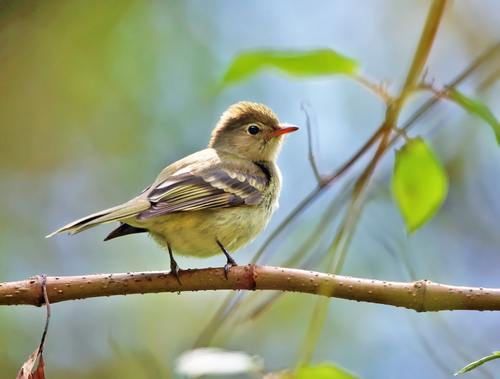
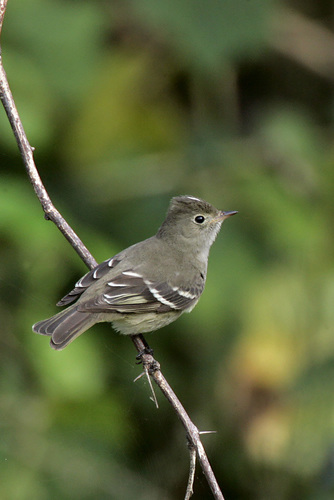
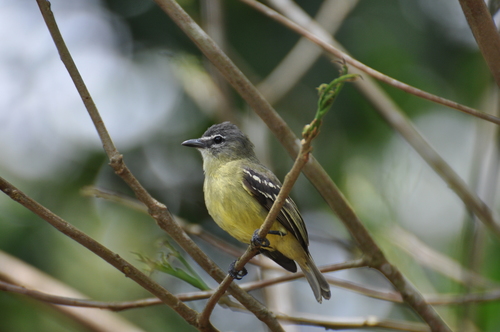
The white-lored tyrannulet (Ornithion inerme Hartlaub, 1853) is 8 to 9 cm (3.1 to 3.5 in) long and weighs approximately 6 to 8 g (0.21 to 0.28 oz). It is a small flycatcher with a relatively thick bill, and sexes have identical plumage. Adults have a gray crown and nape, with a white line crossing the forehead that extends from before to past the eye, gray lores, and an otherwise olive face. Their upperparts are olive. Their wings are blackish, with thin greenish yellow edges along the secondaries. The tips of their greater and median wing coverts are pale yellow, which appear as two rows of spots when the wing is closed. Their tail is grayish, with green edges on the outer feathers. Their throat is whitish, and the rest of their underparts are mostly pale yellow with a light olivaceous wash on the breast and sides. Both sexes have a dark brown iris, a black bill, and dark gray or black legs and feet. Juveniles have ochraceous wing bars, but are otherwise identical to adults. The white-lored tyrannulet has a disjunct distribution, with two separate ranges. The much larger of the two covers almost the entire Amazon Basin, stretching from the base of the Andes in Colombia, Ecuador, Peru, and Bolivia east through southern and eastern Venezuela, the Guianas, and almost the entire northern half of Brazil. The species also occurs along southeastern Brazil's coast, from Alagoas and Bahia south to Rio de Janeiro state. This bird inhabits tropical lowland evergreen forest. It prefers the forest canopy, but appears to be more abundant at forest edges, such as those along watercourses, lakes, and openings created by fallen trees. In Colombia it is often found in terra firme forest, and in Brazil it occurs in várzea forest. Its elevation range varies by location: from sea level to 1,000 m (3,300 ft) in Brazil, up to 500 m (1,600 ft) in Colombia, up to 600 m (2,000 ft) in Ecuador, up to 1,000 m (3,300 ft) in Peru, and up to 950 m (3,100 ft) in Venezuela.