About Orites diversifolius R.Br.
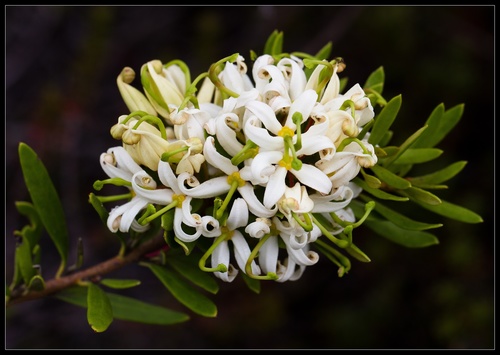
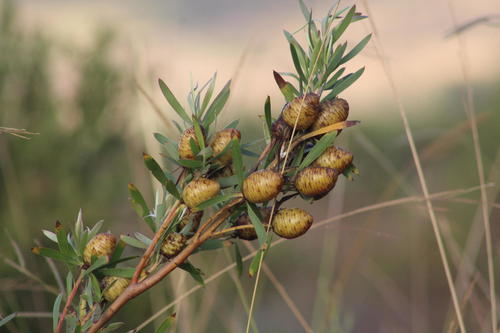
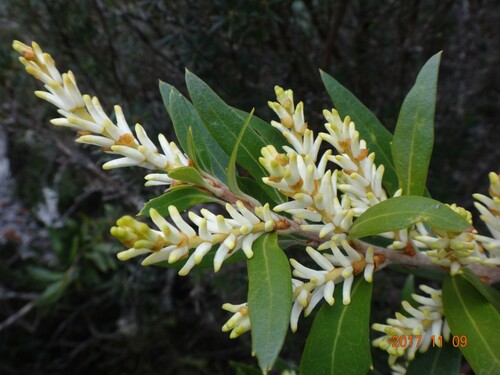
Orites diversifolius R.Br. is an erect, rigid, branching shrub that grows up to 3 metres tall, and can occasionally grow into a small tree when growing conditions are good. Its branches are brown and hairy. Leaves are stiff, leathery, and arranged alternately along stems; both upper and lower leaf surfaces are glabrous. The upper leaf surface is shiny green, while the lower surface is pale and glaucous. Leaf shape is linear but variable, and leaves frequently have serrated edges. Leaf margins are recurved, and the leaves appear almost flat. Leaf size varies significantly based on habitat: subalpine plants have smaller leaves, 3–5 cm long, while leaves from rainforest-growing plants are commonly around 10 cm long. The inflorescences are axillary spikes growing on the upper end of branches, with each spike holding approximately twenty flowers. Flowers are small, sessile, paired in the axils of bracts, and have the characteristic structure of the Proteaceae family. They are sweetly scented, and made up of four cream-coloured petaloid tepals (perianth parts where petals and sepals are indistinguishable) that are 4-5 mm long. Tepals are linear, less than 1 mm wide, and recurved. Each flower has four stamens that extend above the tepals, and a superior ovary. The fruit is a moderately woody, dark brown follicle that splits along one side to release seeds. These boat-shaped follicles grow in small clusters at the ends of branches, and measure 18-24 mm long and 6-8 mm wide. Each follicle holds two or more flattened, winged seeds. This species is endemic to Tasmania. It occurs in lowland rainforest and mixed forest across western Tasmania, and in subalpine woodlands and coniferous heath in south-west Tasmania, up to an elevation of 1300 m. It is common on the subalpine slopes of Mount Wellington, grows throughout much of Mount Field National Park and Southwest National Park, and is also found in southern Bruny Island and around Mt Darwin in the Franklin-Gordon Wild Rivers National Park. The species prefers cool, moist, shady sites, but can tolerate higher light exposure in the subalpine zone by reducing the size of its leaves and its overall plant size. It is tolerant of both frost and snow. It grows in multiple floristic communities that often have dominant or co-dominant species including Atherosperma moschatum, Phyllocladus aspleniifolius, Nothofagus spp., Eucryphia spp. and Leptospermum spp. It flowers in spring, between October and November. Seeds are shed from December to February, immediately after follicles ripen and split open. The seeds of this species have one large terminal wing, indicating wind is their mode of dispersal.