About Orgyia pseudotsugata McDunnough, 1921
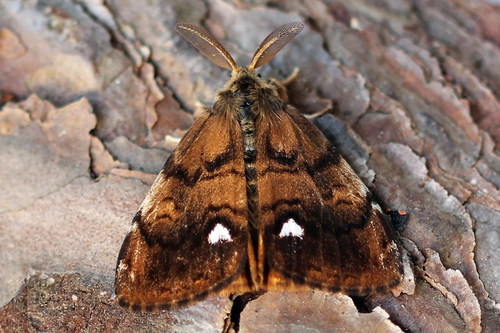
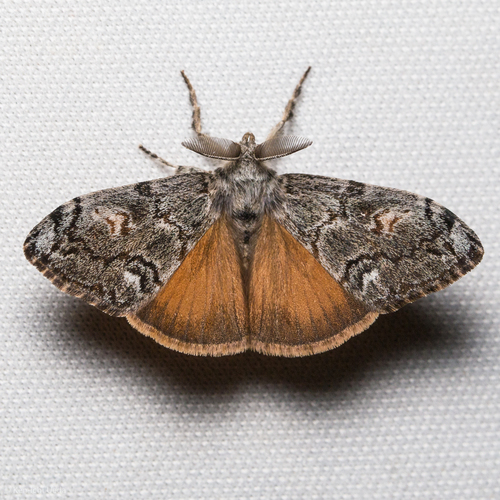
This species, Orgyia pseudotsugata McDunnough, 1921, is commonly known as the Douglas-fir tussock moth. Adult males are grayish brown moths with mottled light and dark markings. Their wingspread ranges from 25–34 mm (0.98–1.34 in). When the wings are held open, the brown hindwings are visible. Individuals from the northern portion of the species’ range are darker, while southern populations are lighter. Males have plumose, or feathery, antennae. Females are flightless, and only have rudimentary wings. Fully grown larvae (caterpillars) measure 20–26 mm (0.79–1.02 in) long. They are colorful, with red spots, white spines, conspicuous red-tipped white tufts called tussocks, and dense bunches of long black hairs that project toward the front and rear. The Douglas-fir tussock moth is native to forests of western North America. Confirmed outbreaks have been recorded in British Columbia, Idaho, Washington, Oregon, Nevada, California, Arizona, and New Mexico. Outbreaks occur in cycles of approximately eight to twelve years, and usually last up to four years, though they can sometimes last longer. A major outbreak was reported in Idaho and Washington in 2011. Larvae feed on Pseudotsuga and Abies species, especially Douglas fir, grand fir, and white fir. Eggs hatch in spring, between May and June. Young larvae begin feeding on new foliage, which is the current season’s needle growth. As they develop, they feed on both new and old foliage. Caterpillar movement is the main form of biological dispersal for the species. The caterpillars produce long, silky threads that can catch the wind when they drop from one branch to another. They spin loose webbing that forms a netting, and pupate inside this structure in July or August. Adults emerge and remain active as late as November. The flightless females stay near the cocoons they emerged from, and mate immediately after emergence. Eggs are spherical, white, and laid in a protective mass that overwinters. Because females are sedentary, population outbreaks always develop in place.