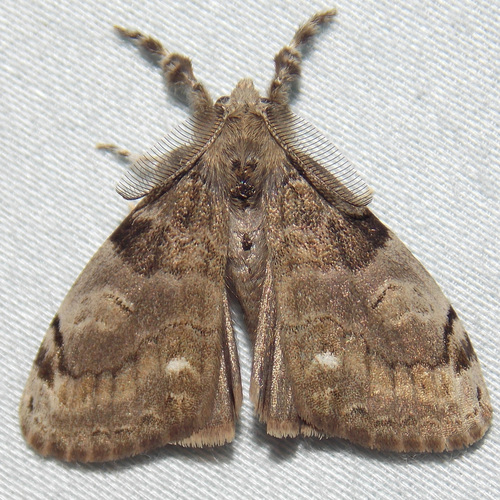
About Orgyia leucostigma J.E.Smith, 1797
Orgyia leucostigma, commonly known as the white-marked tussock moth, is a member of the moth family Erebidae. This species was first formally described by James Edward Smith in 1797. Its caterpillars are very common, particularly in late summer, across eastern North America, with a range extending westward to Texas, California, and Alberta. In eastern North America, this species produces two or more generations each year, and overwinters in the egg stage. The fungus Entomophaga maimaiga was introduced to North America to control the spongy moth, Lymantria dispar. This fungus also infects Orgyia leucostigma, and may have an impact on O. leucostigma populations in years when E. maimaiga is abundant. Large O. leucostigma larvae are mostly attacked by birds, while most small larvae disappear during their dispersal stage.