About Oreostylidium subulatum (Hook.fil.) Berggr.
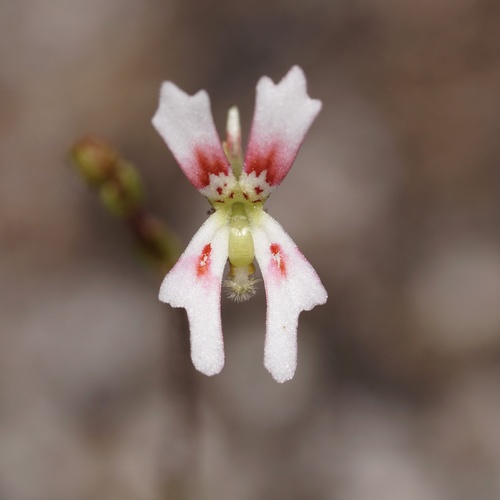
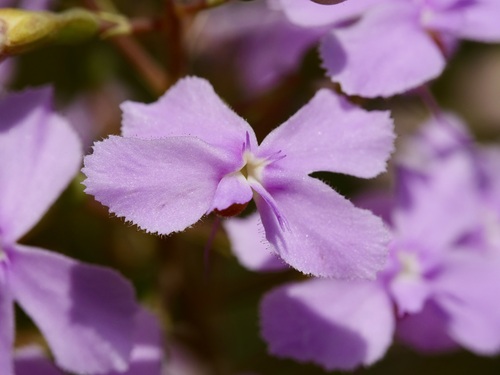
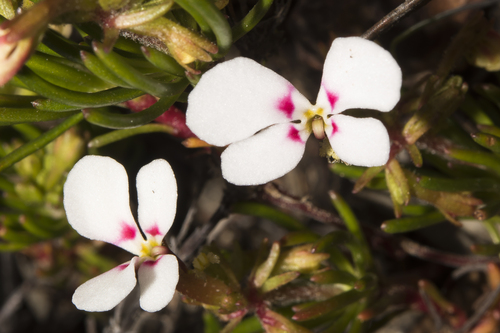
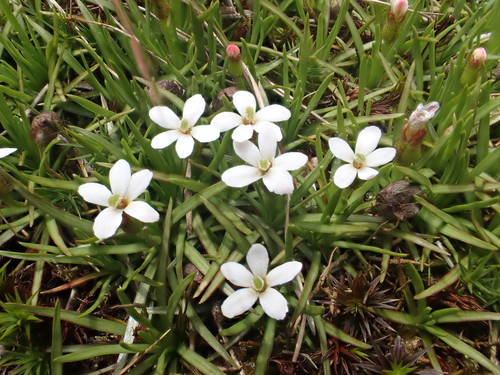
Oreostylidium subulatum (Hook.fil.) Berggr. is a very small, caespitose, densely tufted plant that reaches about 2–3 cm in height. Its linear-subulate leaves, which grow up to 2 cm long, form a basal rosette pressed close to the ground. The leaves are glabrous and have entire margins. A slender, erect scape around 2 cm tall arises from the leaf rosette; like most species in the related genus Stylidium, this scape is covered in glandular trichomes. Each scape bears a single flower. The calyx is erect, stout, and very broad, being nearly as broad as the ovary. The ovary itself is large, oblong, sub-cylindrical, tapering, and jointed to the scape. The flower corolla forms a solitary actinomorphic white flower with five petals, which most closely resembles the flowers of Forstera and Phyllachne, both genera also in the family Stylidiaceae. Like all species of Stylidium, O. subulatum possesses a column formed from fused stamens and stigma. Unlike Stylidium species, however, this column is insensitive and non-mobile, and does not move when exposed to physical stimuli. It has been proposed that the genus Oreostylidium should be merged into Stylidium, but the morphological characteristics of the two genera are not similar. Researchers have suggested that the floral form of O. subulatum developed through an extreme case of paedomorphosis or reduction. This process may have started as a result of O. subulatum becoming isolated on the islands of New Zealand. Researchers believe this species originated in Australia, and became established in New Zealand from a very small founding population, possibly even from a single seed. When adapting to survive in a new environment while retaining a flower originally adapted for specific Australian pollinators, the species underwent rapid morphological changes. Studies put forward the hypothesis that this process led O. subulatum to evolve from a shared ancestral lineage with Stylidium graminifolium into the pollinator-generalist species it is today. It also shifted from the cross-pollination-adapted Stylidium-like flower to obligate autogamous pollination. This shift allowed the plant to carry out sexual reproduction while in a morphologically immature state, because the complex flowers characteristic of Stylidium were no longer required for pollination. O. subulatum is endemic to montane and subalpine regions of New Zealand, and its range is less extensive than that of other Stylidiaceae genera found in New Zealand. In a 1925 review of the geographical distribution of Stylidiaceae, Good recorded that O. subulatum is restricted to the South Island, though older reports mention specimens collected near Mount Ruapehu on the North Island. On the South Island, the species has been recorded growing at Swampy Hill near Dunedin and The Grampians near Nelson, New Zealand.