About Oreocereus celsianus (Lem. ex Salm-Dyck) Riccob.
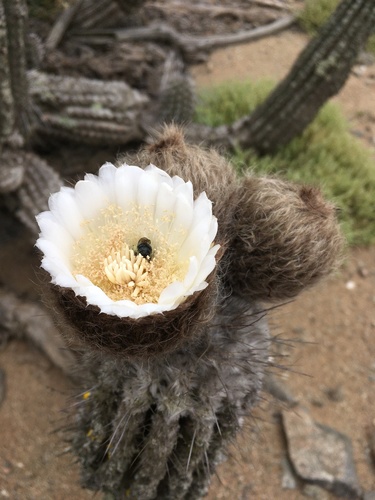
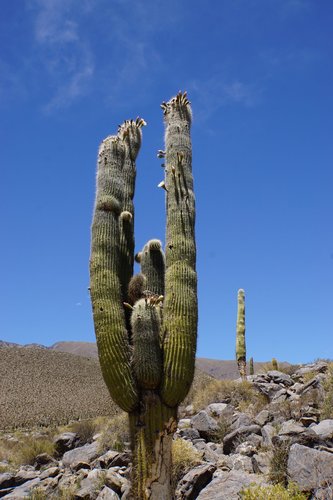
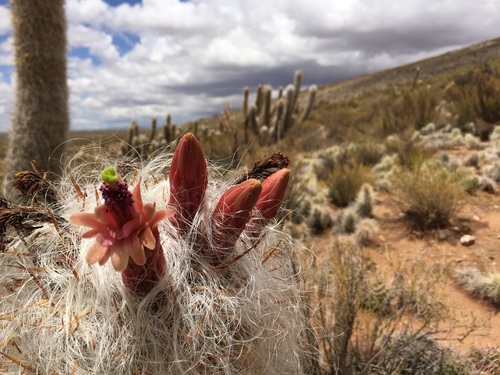
Oreocereus celsianus (Lem. ex Salm-Dyck) Riccob. grows as upright, columnar shoots that branch from the base, reaching up to around 3 metres (10 ft) in height, with a diameter between 8 and 12 cm (3.1 to 4.7 in). The entire plant is covered in downy white hair and spines; this covering is densest at the stem tips, and becomes sparser until the base is nearly bare. It has 10 to 25 vertical, rounded, tuberous ribs, with a typical count of eleven ribs, though researcher Mauseth recorded as many as 29 ribs. The species produces many long, brown spines. Its large areoles are white, densely covered with spines, and have hairs up to 5 cm (2.0 in) long. It produces one to four strong central spines that grow up to 8 cm (3.1 in) long, plus seven to nine radial spines that reach up to 2 cm (0.79 in) in length. Oreocereus celsianus blooms in spring, producing long, tubular, bright slightly purplish-pink flowers near the tips of its shoots. These flowers are 7 to 9 cm (2.8 to 3.5 in) long and reach up to 3 cm (1.2 in) in diameter. Its fruits are spherical, hollow, and filled with an unidentified biogenically produced gas. The species occurs in the Bolivian departments of Chuquisaca, Potosí, and Tarija, Peru, and the Argentine province of Jujuy, where it grows in puna vegetation at altitudes between 2,900 and 3,600 meters. This cactus is pollinated by hummingbirds, primarily by a single species: the southern giant hummingbird Patagona gigas. It is also capable of self-pollination. In cultivation, Oreocereus celsianus grows best at 10–12 °C (50–54 °F), tolerates frost down to −12.2 °C (10.0 °F), requires protection from hot sunlight, and prefers full sun with light watering. It can be propagated either from seed or from stem cuttings.