About Oreocarya cana A.Nelson
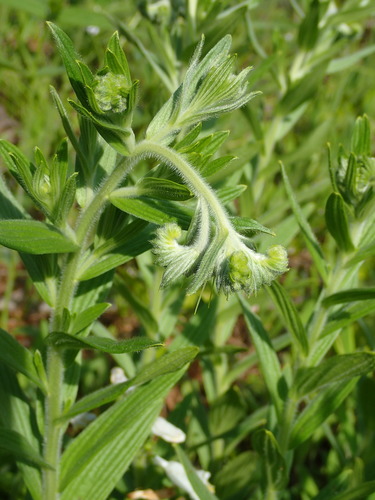
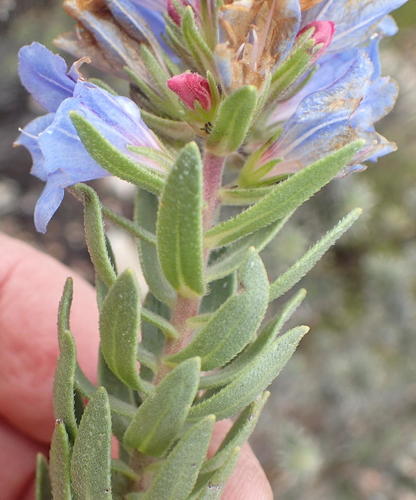
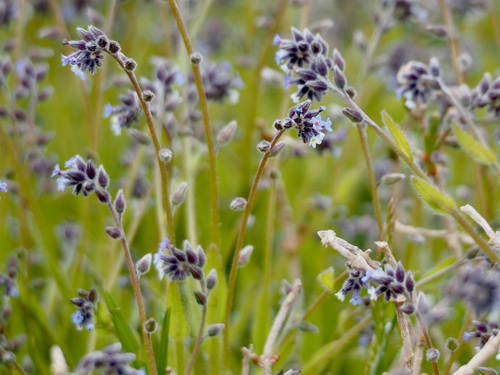
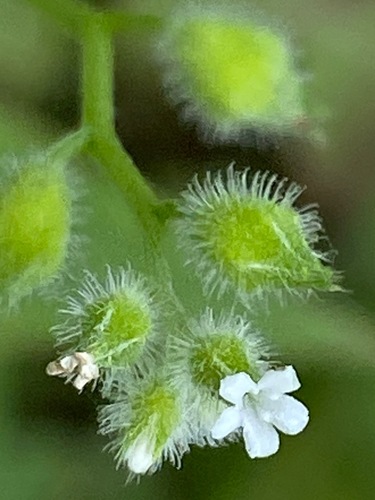
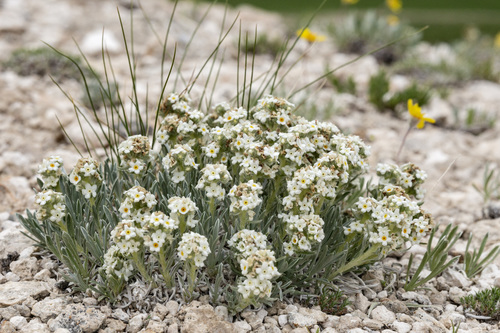
Oreocarya cana (A.Nelson) is a perennial plant that forms caespitose mats from a thick caudex. It produces many narrow inflorescences, which stand 40 to 150 mm (1.6 to 5.9 in) tall and are typically restricted to the upper half of the stem. Stems are densely but weakly covered in bristly hairs, and bear inconspicuous foliar bracts. Sepals are 3–6 mm (1⁄8–1⁄4 in) long and finely covered in setose hairs. Corollas are tubular, made of five fused white petals roughly 3 mm (1⁄8 in) long, and are actinomorphic (radially symmetrical) with prominent yellow eyes called fornices. Leaves are crowded near the main caudex, and shaped as narrowly oblanceolate, reaching 20–60 mm (3⁄4–2 3⁄8 in) in length. Leaves are densely and uniformly silky strigose, which gives them a smooth appearance to the naked eye. The underside (abaxial surface) has very inconspicuous pustules and is covered in bristly setose hairs, while pustules on the upper (adaxial) surface are highly obscured. After successful pollination, this species produces fruit in the form of nutlets. Each flower typically produces only one mature nutlet, though it may produce more. Nutlets are lance-ovoid in shape, usually asymmetrical, and are quite small at just 3–3.5 mm (0.12–0.14 in) long. They have dull surfaces and a scar that is widened at the base. Oreocarya cana is easily distinguished from other species in its region because it is the only species in its genus east of the Rocky Mountains that forms densely caespitose mats. The primary range of Oreocarya cana is the western high plains of the United States, stretching from northeastern Colorado north through eastern Wyoming and western Nebraska into southwestern South Dakota. Disjunct populations have been recorded further west through Wyoming into Carbon and Bighorn counties in Montana, and the species also occurs rarely in North Dakota. All range estimates for this species are based on collected herbarium specimens. Oreocarya cana is typically found at elevations of 3,000 to 6,000 ft (910 to 1,830 m), on sites that receive 12 to 17 in (300 to 430 mm) of precipitation annually. It most often grows on dry, rocky, exposed sites. It often grows as a chasmophyte or lithophyte on sandstone rimrock of bluffs and buttes, and can also be found on rolling plains in either Rocky Mountain Juniper and Rocky Mountain Ponderosa pine forest, or shortgrass prairie ecosystems. Oreocarya cana appears unable to compete with dominant sod-forming grasses of shortgrass prairies, such as Bouteloua gracilis and Bouteloua dactyloides, which make up the climax vegetation of this habitat. It instead grows and flourishes on shaley ridges or gravelly outcrops that periodically protrude through prairie sod. In these habitats, it commonly grows alongside various species of Atriplex, Artemisia, Astragalus, Eriogonum, Eremogone, Physaria, Mentzelia, Penstemon, Townsendia, Phlox, and other similar plants. Blooming typically occurs in May and June. Little in-depth study has been conducted on the ecological interactions of most species in the genus Oreocarya with organisms from other kingdoms. It is known that most species in the genus are pollinated by insects; Lepidoptera and Coleoptera have been observed visiting several Oreocarya species, and almost certainly act as pollinators. Seed dispersal mechanisms for the genus Oreocarya are almost entirely unknown. Nutlets of several species have slightly winged margins, but the size of the wing relative to the nutlet means it likely provides little to no aid for wind dispersal. Seed dispersal via an animal vector is the most plausible explanation for observed long-distance dispersal events.