About Orchis pallens L.
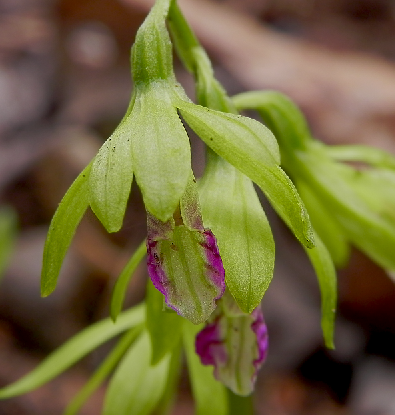
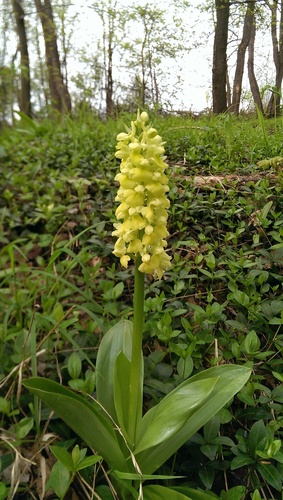
Orchis pallens L. is the least variable species in the Orchis genus. It grows from a round or oval tuber that measures 3–3.5 cm long and 1.5–2 cm in diameter. Numerous 10–20 cm long secondary roots grow underneath the tuber. Above the tuber, it produces 4 to 6 large leaves arranged in a basal rosette. The leaves measure 6–15 cm long and 1.5–5 cm wide, and are sometimes long enough to cover the plant’s flowers. Leaves are unspotted, and can be oblong, oblong-ovate, or lanceolate in shape; they are bright green, shiny, and smooth. In Central Europe, O. pallens is sometimes confused with the yellow-flowering form of the orchid Dactylorhiza sambucina, but the two can be easily distinguished by morphological differences: D. sambucina has leaves that grow distributed along its stem, unlike the basal rosette arrangement of O. pallens. O. pallens has a strong, straight green stem that grows 15–45 cm tall. In the northern part of its distribution range, O. pallens is one of the first orchids to bloom. It flowers in spring, generally from mid-spring to late spring between late April and late May, and sometimes flowers in June. Sources disagree on the scent of its blooms: one compares it to the fragrance of elder tree flowers, another describes it as a foul cat urine-like scent that is most noticeable at night, while a third source describes it as pleasantly and delicately fragrant. Its flowers are pale yellow or yellow. O. pallens can be readily distinguished from the similarly coloured species Orchis pauciflora, Orchis provincialis, and Orchis laeta because its flower lip has no markings at all; all three of these related species have red dots on their flower lips. O. pallens’s unspotted lip is slightly darker than its other petals, contains no nectar, and measures 6-16 mm long and 7-16 mm wide. The lip, or labellum, is slightly trilobed, wider and slightly convex, and longer than the plant’s other petals. It is slightly arched in the centre, has rolled-up edges, and is yellow-greenish. O. pallens can also be easily differentiated from D. sambucina by its yellow bracts that protrude through its inflorescence. O. pallens’s entire flower spike is 4–10 cm long. Its upper outer petals are almost elliptical and blunt, measuring 8-10 mm long and 6-8 mm wide. Its lateral outer petals are similar in size, but asymmetric, blunt, and strongly bent back. Its oval to lanceolate lateral inner petals measure 6-8 mm long and 4 mm wide. Its ovary is 10-15 mm long, narrow, arched, twisted, and green. After flowering, it produces a slightly bloated seed capsule that is 15–20 mm long. O. pallens is widespread across Europe, ranging from northern Spain eastwards across central Europe and the Balkans to the Middle East, Caucasus region, and Asia Minor in the east. It has been recorded in Albania, Austria, Bulgaria, Croatia, Czechia, mainland France and Corsica, Germany, Greece, Hungary, Italy, Poland, Romania, Slovakia, Slovenia, Spain, Switzerland, and Ukraine. It is not found in the British Isles or Scandinavia. The northern limit of its distribution runs through Germany and Poland, mainly southern Poland. Within its range, it occurs in the Baiului Mountains in Romania. In 2014, two new localities of O. pallens were discovered in the Chełm mesoregion of Silesian Upland, southern Poland, near the villages of Ligota Dolna and Oleszka in Opole Province. In Bohemia, it is very rare, growing only at two sites: Strakonice and Podkrkonosi. In Moravia, it grows in more locations including the White Carpathians, Vsetin Hills, Beskydy, and Chriby. O. pallens occurs from lowlands to mountains across most major European mountain ranges, with an altitudinal range between 1,000 to 2,500 m above sea level. It grows in damp meadows, open meadows, shrubland, clearings, inland wetlands, rocky areas including inland cliffs and mountain peaks, and sparse deciduous or coniferous forests or forest edges. Recorded forest habitats include pine forests, beech forests, mixed hornbeam-linden forests, and oak-hornbeam forests. It avoids deeply shaded woodland. It grows on calcareous lime-rich soils, and on unfertilized, slightly moist, fairly alkaline meadows. Even though O. pallens does not produce nectar, its flowers are pollinated by bees, who mistakenly land on it when searching for nectar-producing Lathyrus vernus, spring pea.