About Orchis mascula (L.) L.
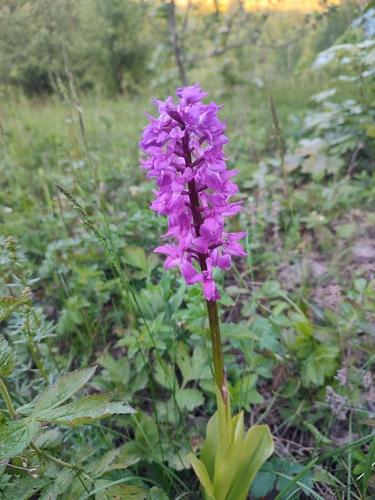
Orchis mascula (L.) L. is a perennial herbaceous plant. Its stems reach 50–60 centimetres (20–24 in) in height, are green at the base, and purple at the apex. Its root system is made up of two rounded or ellipsoid tubers. Leaves are clustered at the base of the stem, are oblong-lanceolate and pale green, and sometimes marked with brownish-purple speckles. The inflorescence is 7.5–12.5 centimetres (3–5 in) long, and holds 6 to 20 flowers arranged in dense cylindrical spikes. Individual flowers are about 2.5 centimetres (1 in) across, and their color ranges from pinkish-purple to purple. Lateral sepals are ovate-lanceolate and erect; the median sepal, along with the petals, is smaller and covers the gynostegium. The labellum is three-lobed and convex, with crenulated margins; its basal area is paler and dotted with purple-brown spots. The spur is cylindrical or club-shaped, and grows either horizontally or angled upwards. The gynostegium is short, and has reddish-green anthers. This species blooms from April to June. This species is widespread across Europe, ranging from Portugal to the Caucasus, including Ireland, Great Britain, the Faroe Islands, Norway, Sweden, Finland, Latvia, Spain, France, Belgium, Netherlands, Germany, Denmark, Austria, Hungary, the Czech Republic, Switzerland, Italy, former Yugoslavia, Albania, Greece, Turkey, Bulgaria, Romania, Poland, Ukraine, and most of Russia. It also occurs in northwest Africa (Algeria, Tunisia, Morocco) and in the Middle East from Lebanon, Syria, and Iraq up to Iran. It can grow in a wide variety of habitats, including meadows, mountain pastures, and woods, in both full sun and shaded areas, at altitudes from sea level up to 2,500 metres (8,000 ft). This orchid produces no nectar, and attracts pollinating insects through flower appearance that mimics other plant species. Known pollinators include bees and wasps from the genera Apis, Bombus, Eucera, Andrena, Psithyrus and Xylocopa, and occasionally beetles. Orchids in the genus Orchis form mycorrhizal partnerships primarily with fungi from the family Tulasnellaceae. Research suggests Orchis mascula only has a single mycorrhizal partner, which belongs to Tulasnellaceae. Ground tubers from this species (or other orchid species) are used to make a flour called salep or sachlav. This flour contains glucomannan, a nutritious starch-like polysaccharide.