About Orchelimum pulchellum Davis, 1909
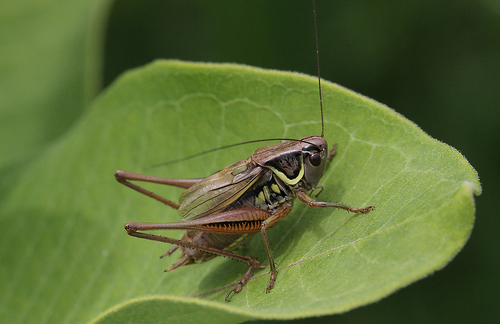
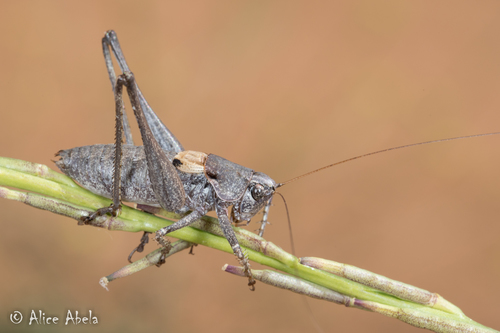
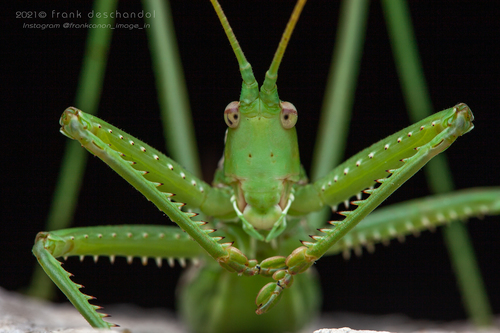
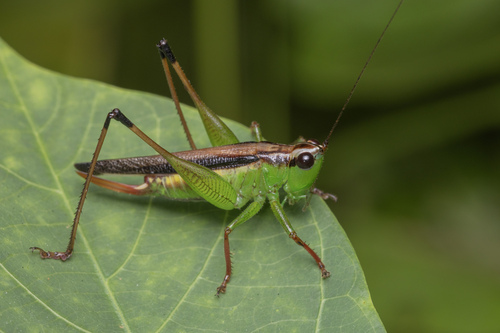
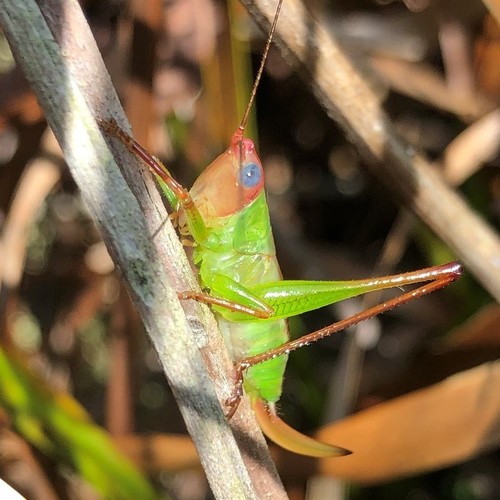
Orchelimum pulchellum Davis, 1909, commonly called the handsome meadow katydid, has a body length ranging from 18 to 23 millimetres (0.71 to 0.91 inches). It can be distinguished from its western relative Orchelimum nigripes by several traits. In O. pulchellum, the caudal portion of the lateral pronotum is arcuate below the humeral sinus, while this portion is sinuate or sub-sinuate in O. nigripes. In males of O. pulchellum, the medial tooth on each of the paired cerci sits at a less acute angle to the sinuate sinus of the cercus than it does in O. nigripes. Females of O. pulchellum have a long, sickle-shaped ovipositor. O. pulchellum has brown tibiae, while O. nigripes tibiae are typically black. Unlike its relative O. carinatum, O. pulchellum usually has no spines on the inner carinae of the hind femora. It differs from its Texas relative O. bullatum by having a narrower fastigium, and spines on the outer ventral carinae of the hind femora that generally number at least six in total when counting both legs. O. pulchellum commonly has blue compound eyes, a trait it shares with O. erythrocephalum, set on its white or yellow face. When at rest, its folded wings appear to have a turquoise stripe; its body is green, with reddish marks around the head. The song of the handsome meadow katydid is very similar to that of Orchelimum nigripes: it consists of a series of paired clicks, occasional single clicks, that lead into a short buzz. The handsome meadow katydid is distributed east of the Appalachian Mountains, reaching as far north as New York state. Its range extends south to Florida and west to Mississippi. This katydid lives in moist forests and wetlands. It feeds on pollen from flowering plants and foliage. In Alabama, it is active from mid-July through mid-November.