About Opuntia sulphurea G.Don ex Loudon
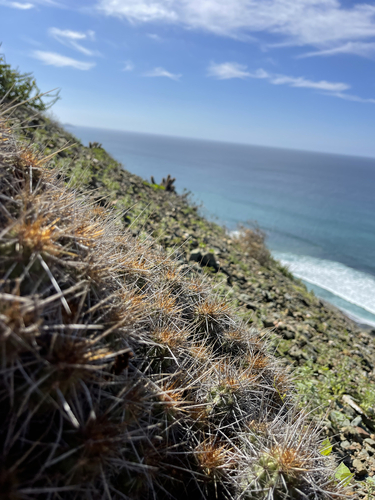
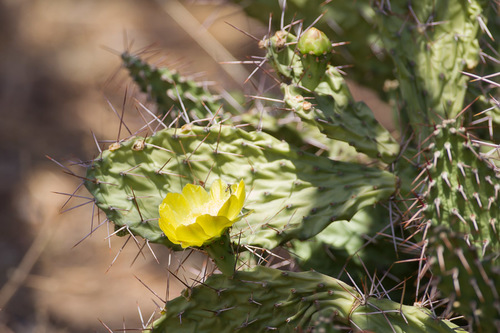
Opuntia sulphurea G.Don ex Loudon is a prickly pear cactus distinct from many other cacti—even other members of the Opuntia genus—because it grows low to the ground, spreading wider rather than taller, forming large clumped groups that reach no more than 40 cm above ground. It is made up of many individual elliptic to ovolid pads that each act as a single organism and stay clustered tightly together; these pads measure 15 to 20 cm long and 10 to 13 cm wide. The areoles have a corrugated appearance from the tuberculate structure of the plant’s joints, and average 4 mm by 3 mm in area. Most areoles bear spines that change color as the areole and spine mature: young spines are pink, while mature spines turn gray or dark. These spines are thick, stiff, needle-shaped, grow 3–10 cm long, and often twist as they mature. The species produces bright yellow flowers that typically reach around 4 cm in length, with exterior, intermediate, and interior tepals. Its fruits vary in color from yellowish to reddish. The species is mostly found in, and thought to originate from, northwestern Argentina, ranging from Mendoza province north to Jujuy and west to Buenos Aires province. It also occurs in parts of Paraguay, Bolivia, Chile, and western Brazil, with a well-documented naturalized population in localized areas of southern Queensland, Australia. It can live at a wide range of altitudes, from sea level up to 3,500 meters. Kiesling and Ferrari’s work on Argentine cacti documented three geographic fruit color variants of Opuntia sulphurea: the nominal sulphurea variant, which produces the characteristic yellow fruit and occurs from Mendoza province to Catamarca province; the hildemannii variant, which produces red fruit and grows near Bolivia’s southern border; and the pampeana variant, named for the Pampas region of central Argentina where it grows. None of these variants are formally recognized as official subspecies. This prickly pear species grows successfully in a wide variety of environments, but favors cool, arid regions. It most often grows in rocky soils on hillsides from sea level upward, though it can also thrive in clay-heavy soils. It prefers nitrogen-rich soils, so it grows particularly well in overgrazed areas. A study conducted by Eduardo Méndez in Mendoza, Argentina found that Opuntia sulphurea population density increased from 1.3 plants per 100 square meters in lightly grazed areas to 15.9 plants per 100 square meters in overgrazed areas, meaning the presence of this cactus can indicate past overgrazing. Méndez hypothesized that cattle grazing facilitates this species’ asexual agamic propagation via its cladodes (its elliptical stems), because the cactus prefers eutrophic, nutrient-rich areas created by grazing. Due to its ability to survive in many environments and thrive where other plants cannot, Opuntia sulphurea is not endangered, and is listed as Least Concern on the IUCN Red List. It can also act as an invasive species. The species has no common current uses, but its cladodes store water, contain high levels of protein and large amounts of stored fatty acids (including significant linolenic acid content), so it could be used as a food source in the future. It is already used by local rural communities, and if its use becomes more widespread, its resilience and wide distribution would likely give it significant economic impact.