About Opuntia stricta (Haw.) Haw.
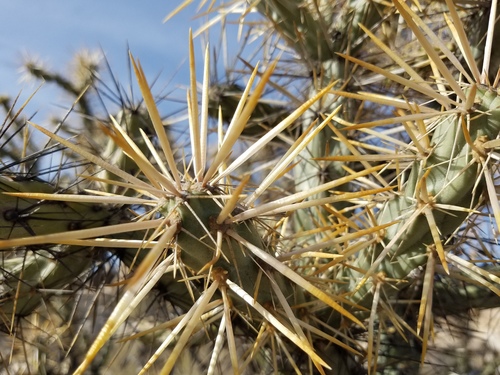
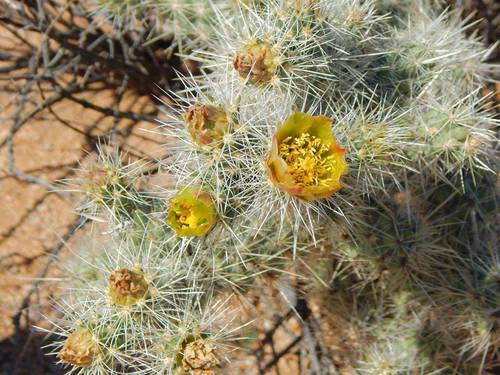
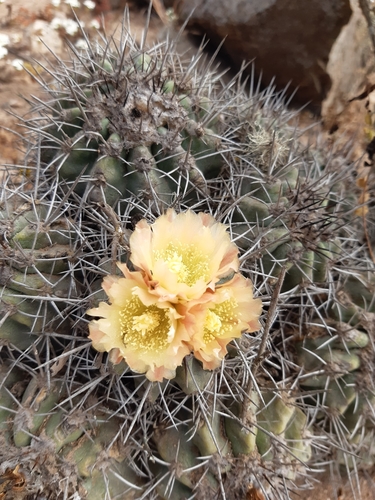
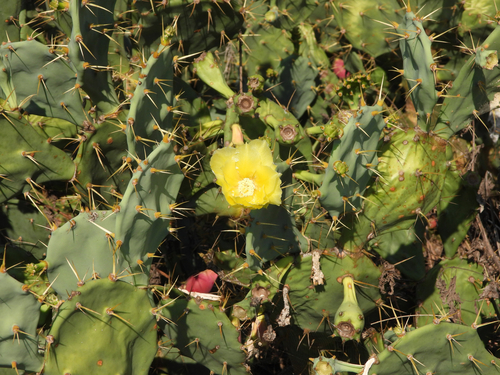
Opuntia stricta (Haw.) Haw. is an erect, shrubby cactus that can grow up to 2 meters (6.6 feet) tall. Its blue-green flattened shoot segments are hairless, ovate to obovate (inverted egg-shaped), tapered at the base, 25 to 64 centimeters (10 to 25 inches) long, and 15 to 64 centimeters (6 to 25 inches) wide. Brownish areoles are widely spaced, leaving most of the shoot epidermis exposed. Areoles typically bear one or more yellowish spines, especially near the shoot edges and apex, along with prominent yellow glochids 2 to 6 millimeters (0.079 to 0.236 inches) long. There are 1 to 5 yellow, flattened, awl-shaped spines with small light barbs at the tip; these spines grow perpendicular to the shoot surface and measure 1.3 to 12.7 centimeters (0.5 to 5 inches) long. Its solitary flowers, which open for only a short time and produce nectar for pollinators, are yellow to yellowish-orange, made up of many membranous segments, and measure 13 to 15 centimeters (5 to 6 inches) long with a diameter of 10 to 15 centimeters (4 to 6 inches). This species blooms in spring and summer, producing lemon yellow flowers, followed by fruits that ripen to a purplish-red color. The mature fruits are smooth, inverted egg-shaped, tapered at the base, generally pyriform (pear-shaped), always purple, and covered in many glochids. Fruits are 6.4 to 8.9 centimeters (2.5 to 3.5 inches) long and 4 to 6 centimeters (1.6 to 2.4 inches) in diameter. Each fruit contains 60 to 180 yellow to light brown seeds embedded in the fruit pulp; these seeds can remain viable for more than 10 years. Fruits are consumed by birds and mammals, which disperse the plant’s seeds. O. stricta colonizes hot, open sandy-soil environments very quickly. Naturally, it occurs in coastal beach scrub and sandy coastal habitats in the United States (South Carolina, Georgia, Florida, Louisiana, Mississippi, Alabama, and Texas along the Gulf Coast), as well as in Bermuda, the Caribbean, eastern Mexico, Central America, and northern South America (Venezuela and Ecuador). It is a major understory component of Bahamian dry forests in the Bahamas and the Turks and Caicos Islands. The mucilage contained in its pads is traditionally used to treat burns and abscesses. Both its fruits and pads are edible.