About Opuntia microdasys (Lehm.) Pfeiff.
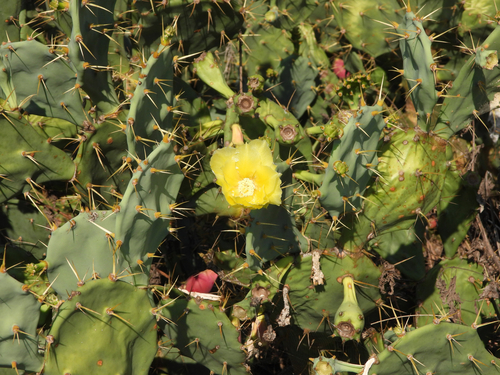
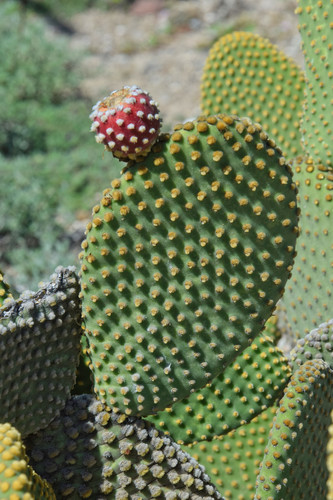
Opuntia microdasys (Lehm.) Pfeiff. grows as a dense shrub, typically reaching 40 to 60 centimeters tall, and occasionally grows taller. It is made up of pad-shaped stems that are 6 to 15 centimeters long and 4 to 12 centimeters wide. Unlike many cacti, it does not have spines. Instead, it produces many dense clusters of white or yellow glochids that are 2 to 3 millimeters long. These glochids are barbed, thinner than the finest human hairs, and detach from the plant in large numbers when touched even very lightly. If they are not removed from skin, they cause significant irritation, so this plant must be handled with caution. Its Latin specific epithet microdasys translates to "small and hairy". Yellow flowers on this species are produced only very rarely. Even so, it is a very widely cultivated cactus, in part because young plants have a comical resemblance to a rabbit's head. This cultivar has received the Royal Horticultural Society's Award of Garden Merit. This species is native to Mexico, and has become naturalized in Kenya, Malawi, and Tanzania. Its efficient ability to collect fog is one reason that O. microdasys thrives in desert habitats, both in its native range and as an introduced species. The glochid hairs have an ideal structure and microstructure to capture and channel fog.