About Opuntia humifusa subsp. minor (Engelm.) R.Crook & Mottram
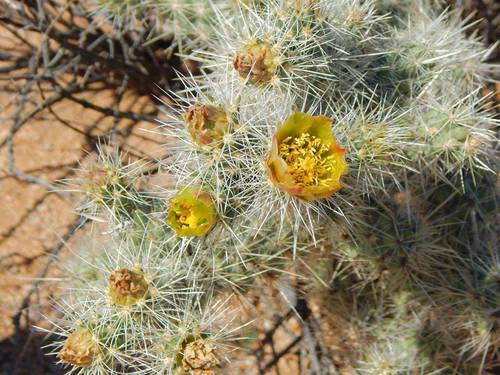
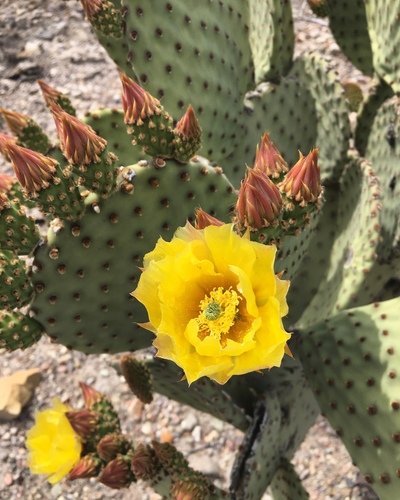
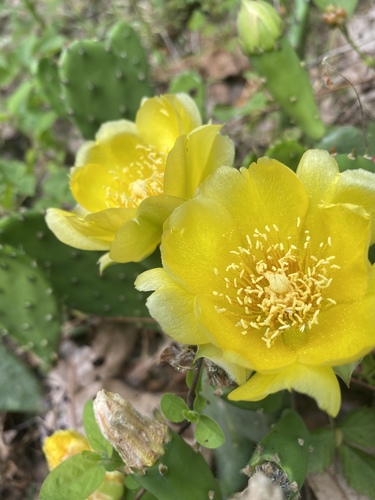
This is a low-growing, perennial cactus in the genus Opuntia. Like other species in this genus, its green stems are flattened and divided into segments. Barbed bristles cover the surfaces of these segments, and longer spines sometimes develop. Flowers range from yellow to gold in color, grow along the margins of mature segments, have a waxy texture, and sometimes feature red centers. Flowers measure 4–6 cm (1+5⁄8–2+3⁄8 inches) across, and this cactus blooms in late spring. The ripe juicy fruits are red or purple, and measure 3–5 cm (1+1⁄8–2 inches) long. Unripe fruits are green, and change to red as they mature; fruits often stay attached to the cactus until the following spring. Each fruit contains between 6 and 33 small, flat, light-colored seeds.
This taxon naturally occurs along the East Coast of the United States, including on barrier islands ranging from the Florida Keys to coastal Massachusetts. Scattered populations are found eastward from New Mexico and Montana, and it is one of two cactus species native to the eastern United States, alongside the related O. cespitosa. It grows in hot, sunny areas with thin, non-water-retentive soil, which includes shale barrens in the Appalachian Mountains. These shale barrens are accumulations of thin, flat, eroded sedimentary rock on steep slopes with southern exposures, forming an essentially desert microclimate. In Canada, it grows naturally in small pockets of Southern Ontario along the banks of Lake Erie.
This plant is highly intolerant of shade, and thrives in sunny, hot, dry environments with well-draining, sandy soil. It grows in open areas within sandy, rocky, and coastal scrub habitats. Unlike many cacti, it can survive cool winters, though harsh winter storms are known to cause habitat loss.
The fruits are edible, but have small spiny bristles. Their pulp can be scooped out and seeds strained to make syrup or jelly. Seeds can be briefly roasted and ground into meal. Young cactus segments can be roasted to remove spines, then peeled and sliced to eat like string beans; they can also be deep fried. Peeled leafy segments can be chewed for emergency hydration. Opuntia humifusa has been used for traditional medicine in Indigenous North American, American, Mexican, and Korean cultures. Stem extracts from this plant have high concentrations of polyphenols and flavonoids, and it is known to host endophytic fungi.