About Opuntia fragilis (Nutt.) Haw.
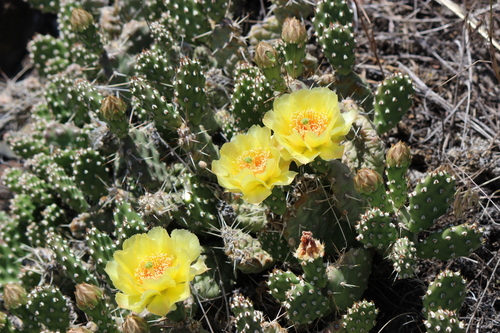
Opuntia fragilis (Nutt.) Haw. is a small, prostrate cactus that reaches up to 20 centimetres (8 in) in height. Its stem joints are swollen, fragile, easily detached, and shaped oval, elliptical, or subglobose; they measure 3–5 cm (1–2 in) long, are nearly as thick as they are broad, and are bright green in color. Areoles are spaced 0.6–1.3 cm (1⁄4–1⁄2 in) apart, covered with whitish wool and a small number of white to yellow bristles. These bristles are much longer and more abundant on older joints. The species produces 2–7 spines up to 1–6.5 cm (1⁄2–2+1⁄2 in) long, plus 1–3 very short additional spines. The spines are dark brown and weak, with the upper spine typically longer and sturdier than the others. Its flowers are greenish yellow and 2.5–3.2 cm (1–1+1⁄4 in) wide. The fruit is shaped ovate to subglobose, bears few spines or bristles, is mostly sterile, grows up to 2.5 cm (1 in) long, and contains many seeds.
In terms of distribution and habitat, Opuntia fragilis is native to every US state located west of North Dakota and Texas, as well as several midwestern US states including Minnesota, Illinois, Iowa, Wisconsin, and Michigan. Within many of these states, it is only found in a single area; for example, it only occurs in Siskiyou County, California, at the northern edge of the state. It also grows in every Canadian province from Ontario to the Pacific Coast. This species is found farther north than any other cactus, occurring as far north as 56°N latitude in British Columbia. An isolated, potentially genetically unique population of Opuntia fragilis called the "Kaladar population" exists in Eastern Ontario. It grows on rock outcrops, dry grassy knolls, and in sandy soil, alongside sagebrush and junipers.