About Opuntia ficus-indica (L.) Mill.
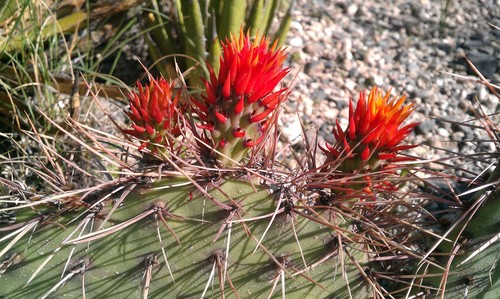
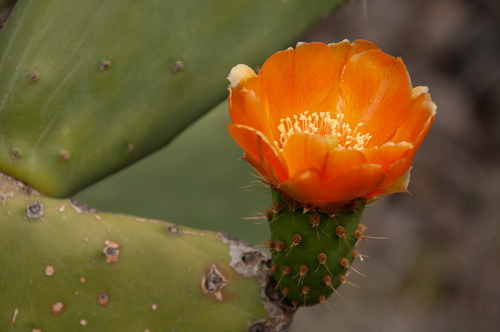
Opuntia ficus-indica (L.) Mill. is a polyploid, hermaphroditic, and autogamous species of prickly pear cactus. It grows as a perennial shrub, reaching up to 5 meters (12–16 feet, or 3.7–4.9 meters) in height. It has thick, succulent, oblong to spatulate stems called cladodes, covered by a water-repellent, sun-reflecting waxy epidermis. As an Opuntia species that grows in semiarid environments, water is the main limiting factor for its growth, and it has developed multiple adaptations to dry conditions, most notably succulence. Flowers are produced on cladodes that are 1–2 years old, and occur in three distinct colors: white, yellow, and red. In the Northern Hemisphere, flowers first emerge from early May through early summer, and fruits ripen from August through October. Mature fruits range in color from pale green to deep red, and have bright red/purple or white/yellowish flesh that contains many tiny hard seeds. The seeds are usually swallowed when the fruit is eaten, but people who have difficulty digesting seeds should avoid consuming them. The fruit, called tuna, is typically eaten after chilling in a refrigerator for a few hours and removing the thick outer skin, and has a flavor similar to sweet watermelon. O. ficus-indica is cultivated commercially for its large, sweet tunas, with Mexico being a major area of tuna cultivation. It is grown both wild and cultivated in many frost-free regions across the world, including the Southern United States, and is naturalized with widespread distribution in Greece. In Namibia, it is a common drought-resistant fodder plant. In parts of Australia, particularly southeast Queensland, some inland areas of New New South Wales, Victoria, and south-eastern and eastern South Australia, prickly pears including this species are a major weed problem. This plant is also classified as an invasive species in northern Africa.