About Opuntia basilaris Engelm. & J.M.Bigelow
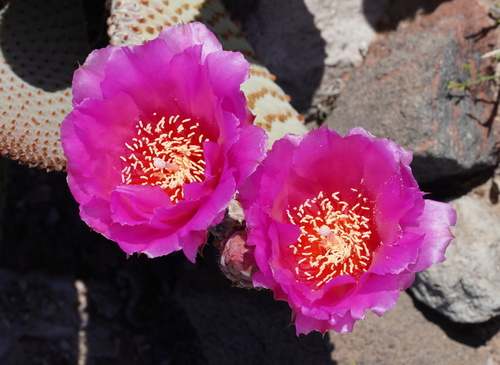
Opuntia basilaris is a small to medium-sized prickly pear cactus that grows 70–400 mm (2.8–15.7 in) tall and produces pink to rose-colored flowers. A single individual can be made up of hundreds of fleshy, flattened pads. Depending on the variety, pads are more or less blue-gray, measuring 50–210 mm (2.0–8.3 in) long, less than 100 mm (3.9 in) wide, and 10–15 mm (0.4–0.6 in) thick. This cactus is typically spineless, but like most Opuntia species, it has many small barbed bristles called glochids that easily penetrate skin. It blooms from spring to early summer. This cactus species occurs in the Southwestern United States, including California, Nevada, Arizona, and Utah, as well as in Northwestern Sonora, Mexico. It grows in chaparral, desert, and grassland habitats, in well-draining substrates made of sand, gravel, or cobble, and can even grow directly on boulders. Multiple Native American groups have traditional uses for Opuntia basilaris, commonly called beavertail prickly pear. The Cahuilla people used this cactus as a staple food: they cooked or steamed the buds, which were then eaten or stored, and ground the large seeds into mush to eat. The Diegueño people ate this cactus as dried fruit after removing the spines. The Shoshone tribe used the cactus for analgesic purposes, creating a poultice from its inner mucilage to treat minor cuts.