About Oplopanax horridus (Sm.) Miq.
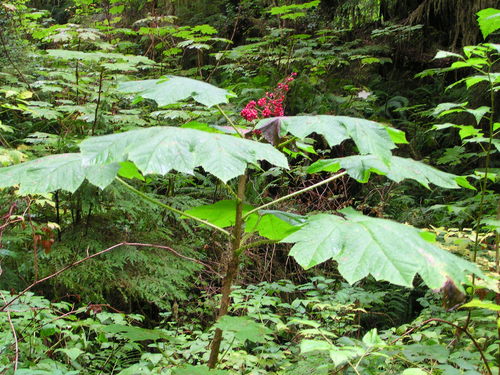
Devil's club (Oplopanax horridus (Sm.) Miq.) generally grows 1 to 1.5 metres (3½ to 5 ft) tall. Some stands growing in rainforest gullies or moist, undisturbed areas can reach 3 to 5 m (10 to 16½ ft) or more in height. Spines grow along the upper and lower surfaces of leaf veins, as well as on the plant's stems. Its leaves are arranged spirally on stems; they are simple, palmately lobed with 5–13 lobes, and measure 20 to 40 centimetres (8 to 15½ in) across. Flowers are produced in dense umbels 10 to 20 cm (4 to 8 in) in diameter; each flower is small, with five greenish-white petals. The fruit is a small red drupe 4 to 7 millimetres (⅛ to ¼ in) in diameter. The entire plant is covered with brittle yellow spines that break off easily when the plant is handled or disturbed, and it has been described as having a "primordial" appearance. Devil's club is slow growing and takes many years to reach seed-bearing maturity, which makes it very sensitive to human impact, as it does not reproduce quickly. It reproduces by forming clonal colonies via rhizomes: what may appear to be multiple separate plants can actually all originate from one original plant, with clones detaching after they become established by growing their own roots. This species usually grows in moist, dense forest habitats, and is most abundant in old-growth conifer forests of the Pacific Northwest. Its range extends from southcentral Alaska south to Oregon, and eastward to western Alberta and Montana. Disjunct native populations also occur over 1,500 kilometres (930 miles) away in the Lake Superior region: on Isle Royale and Passage Island, Michigan, and on Porphyry Island and Slate Island, Ontario. Bears and other wildlife eat the berries of devil's club. The berries are inedible to humans, and touching the spiny plant may cause skin irritation. Traditionally, charcoal from devil's club stalks is still used to make ceremonial and protective face paints. Among the Ditidaht and neighboring Indigenous groups, this charcoal was equally as significant as red ochre as a symbolic link to the spirit world. Indigenous peoples including the Tlingit and Haida have used the plant as traditional medicine to treat ailments such as adult-onset diabetes and rheumatoid arthritis. Devil's club is used ceremonially by the Tlingit, Tsimshian, and Haida people who live in Southeast Alaska and coastal British Columbia. Hanging a piece of devil's club over a doorway is said to ward off evil. The plant is harvested and used in a variety of ways: it is most commonly prepared as an oral tea in traditional settings, but is also made into poultices and ointments. Native Americans also dried and pulverized the bark to use as a deodorant, and used mashed berries to clean hair. Because devil's club is related to American ginseng, some people market the plant as an "adaptogen", and it has been harvested for this purpose and sold widely as "Alaskan ginseng". Despite morphological similarities between devil's club and other araliaceous members including Panax (true ginseng) and Eleutherococcus senticosus (Siberian ginseng), these different genera are chemically diverse.