About Oplismenus compositus (L.) P.Beauv.
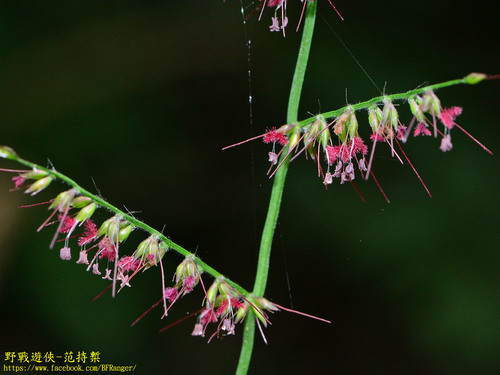
Oplismenus compositus (L.) P.Beauv. is a plant that grows 15 to 150 centimetres (5.9 to 59.1 inches) in length. Its leaves are lanceolate to ovate, measuring 2 to 16 centimetres (0.79 to 6.30 inches) long and 8 to 35 millimetres (0.31 to 1.38 inches) wide. The leaf blades are venated with obscure cross veins, and their apex is acuminate or slightly acute. The inflorescence of O. compositus is made up of unilateral racemes that grow along one side of the central axis, with each raceme measuring 2.5 to 11 centimetres (0.98 to 4.33 inches) long. The central inflorescence axis is 5 to 25 centimetres (2.0 to 9.8 inches) long, has an angular rachis, and is either glabrous or pilose on the lower section. Fertile spikelets are arranged in 2 rows, and include both pedicelled and sessile individuals. The pedicels are oblong. Each spikelet is lanceolate, measures 2.5 to 4 millimetres (0.098 to 0.157 inches) long, contains one basal sterile floret and one fertile floret, and does not have an extended rhachilla. Glumes are shorter than the spikelet and thinner than the fertile lemma. The lower glume is ovate, and bears an awn 3 to 10 millimetres (0.12 to 0.39 inches) in length. The upper glume is also ovate, is herbaceous, has a glabrous or pubescent surface, is obtuse, and bears an awn 0 to 4 millimetres (0.00 to 0.16 inches) in length. Florets measure 2 to 2.5 millimetres (0.079 to 0.098 inches) in length, and are pubescent, emarginate, and mucronate. Both glumes and florets are 1-keeled, but differ in vein count: glumes have 5 veins, while florets have 7 to 11 veins. The fruit is linear and measures 0.5 millimetres (0.020 inches) in length.