About Ophrys sphegodes subsp. sphegodes
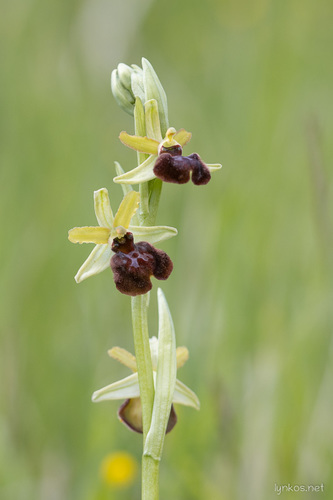
This taxon is Ophrys sphegodes subsp. sphegodes, also called the early spider orchid. Plant height of this subspecies varies with latitude: in the United Kingdom, maximum height reaches around 20 cm (8 in), while plants growing around the Mediterranean can reach up to 70 cm (28 in). It flowers between March and May, with flowering occurring between April and May in more northern latitudes. Each individual shoot can produce between 2 and 18 flowers. Its flowers have yellow-green sepals and a velvety red-brown labellum marked with a distinctive silvery-blue H shape, making the flowers closely resemble an arthropod, and especially a spider. It is similar in appearance to Ophrys fuciflora (late spider orchid) and Ophrys apifera (bee orchid), but can be told apart by petal size: in late spider orchid and bee orchid, petals are much smaller than sepals, while in early spider orchid, petals and sepals are similar in size. It can also be distinguished from these two species by the color patterning on the labellum: late spider orchid has a yellow point at the center of the distal end of the labellum, while bee orchid has a red patch at the proximal end of the labellum. This subspecies grows in unimproved alkaline meadows, woodland edges, slopes, banks, and waste land. It is widespread across most of Europe and the Middle East, ranging from Britain south to Portugal and east to Iran. In Britain, it is restricted to parts of Dorset, Hampshire, Kent, and Sussex, and is considered a rare plant. Even though it is rare overall, populations where it does occur can include hundreds of individual plants. It is classified as a British Red Data Book plant. Despite its apparent vulnerability, it has successfully colonized chalk spoil dumping grounds at Samphire Hoe near Dover, an area created from excavations for the Channel Tunnel. As of 2018, the IUCN lists this taxon as having a global conservation status of least concern. In the United Kingdom, Ophrys sphegodes is pollinated by Andrena nigroaenea, a polylectic miner bee that visits many different flower species and requires dry sandy soils. Different subspecies of Ophrys sphegodes have evolved to attract different pollinators, and this orchid species can form symbiotic relationships with a wide range of mycorrhizal fungi species.