About Ophrys L.
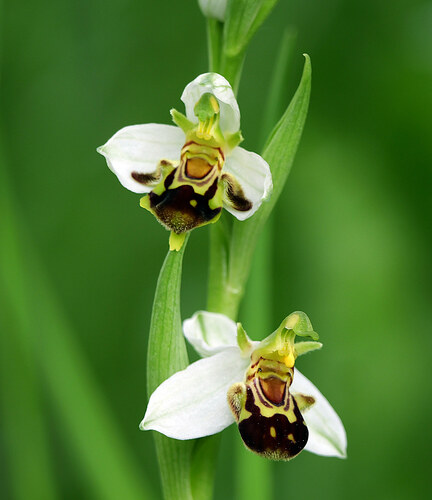
Ophrys apifera, a species in the genus Ophrys, reaches a height of 15–50 centimetres (6–20 in). This hardy orchid grows small leaf rosettes in autumn, which continue to grow slowly through winter. Basal leaves are ovate or oblong-lanceolate, while upper leaves and bracts are ovate-lanceolate and sheathing. All leaves have parallel venation. The species blooms from mid-April in continental Europe, but flowers from June to July in the United Kingdom. It produces a flower spike holding one to twelve flowers. Three large purple sepals surround the base of the flower, and are often mistaken for petals. The true petals are two short, hairy green structures that protrude sideways from the plant’s central column, lying just above the sepals. A third modified petal, called the labellum, sits at the bottom of the column and acts as a landing pad for pollinators. The labellum is trilobed, with two distinct humps on its hairy lateral lobes. Its hairy median lobe has a pattern that mimics a bee’s abdomen, and labellum colouration varies quite widely between individuals. The central column is an orchid-specific adaptation where stamens and pistil fuse into a single central structure. The anther cap sits on the top dorsal side of the column, while the stigma is hidden below on the ventral side. Two pollinia hang from the column over the labellum. Ophrys apifera is widespread across central and southern Europe, North Africa, and the Middle East. Its range extends from Portugal, Ireland and Denmark eastward to Iran and the Caucasus. It is quite common in the Mediterranean region east to the Black Sea, but is less common across its northern range, and is uncommon or found only locally in Germany and Ireland. In the United Kingdom, it has a clear preference for the southeast and is more common in England. In recent years, it has been found in southwest England at Butleigh near Glastonbury (Somerset) and Dorchester (Dorset). In Wales, it occurs only in coastal regions, plus Hodbarrow Nature Reserve in Millom, Cumbria, and some parts of Northern Ireland. It is relatively common in northeast England, and large populations have appeared in recent years on grass verges around the Metro Centre in Gateshead. In Scotland, it was thought to be extinct until it was rediscovered in Ayrshire in 2003. Plants of this species have protected status in some countries. An unusual trait of this species is that it can appear in great numbers some years, and then not reappear for many years after. According to Pierre Delforge’s Orchids of Britain and Europe, the genus Ophrys is the most species-rich, or most diverse, genus of orchids in Europe and the Mediterranean, with over 200 described species. Ophrys apifera typically grows on semi-dry turf, in grassland, on limestone, in calcareous dunes, or in open woodland areas. It prefers well-drained, low-nutrient calcareous soils, and can grow in both bright and dim light. It is a major colonizer of sites disturbed by human activity, including old quarries, roadside verges, and airfields. It is one of the European orchid species most likely to become established within towns and cities. To get enough nutrients from the substrate it grows in, Ophrys apifera depends on a symbiotic relationship with mycorrhizal fungi in the genus Tulasnella, and possibly other fungal genera. Bee orchids are threatened by mowing that occurs during flowering, or before the plant releases its seeds. They also often disappear from sites that become overgrown with shrubs and trees, since the orchids cannot compete with these larger plants for light. For these reasons, bee orchids are often found on the edges of mown areas, beside paths, or in areas that are mown very infrequently. The Sussex Wildlife Trust recommends mowing at the end of July and removing cuttings to support bee orchid populations. In prehistory, the species most likely relied on seasonal grazing pressure, or was restricted to early succession habitats and permanent grassland. Ophrys apifera is thought to preferentially self-pollinate. In the northern parts of its distribution, its flowers are almost exclusively self-pollinating. In the Mediterranean region, where the species is more common, it is pollinated by the solitary bee Eucera longicornis. Males of Eucera longicornis have been observed trying to copulate with the flowers, which produce allomones that mimic the scent of a female bee. These allomones also attract the bee species Tetralonia cressa and Eucera pulveraceae. In addition to this chemical mimicry, the flower’s labellum acts as a visual decoy that male bees mistake for a female bee. It is thought that male bees preferentially choose orchids with the most bee-like labellum and attempt copulation. During this pseudocopulation, pollinia stick to the bee’s body, which allows for pollen transfer and potential pollination. Like all orchids, Ophrys species depend on symbiotic fungi during at least one stage of their life cycle. This dependence is especially strong for seed germination, which can take months or even years while the seed develops underground. Orchid roots hold orchid mycorrhiza, which are coils of fungal hyphae that grow inside orchid root cells.