About Ophiopogon japonicus (Thunb.) Ker Gawl.
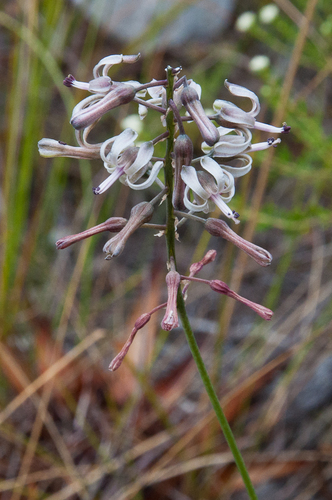
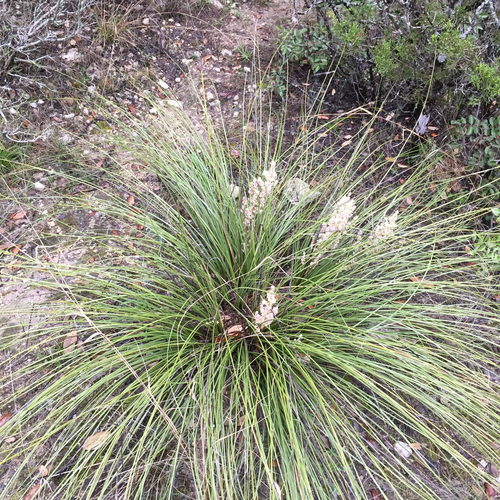
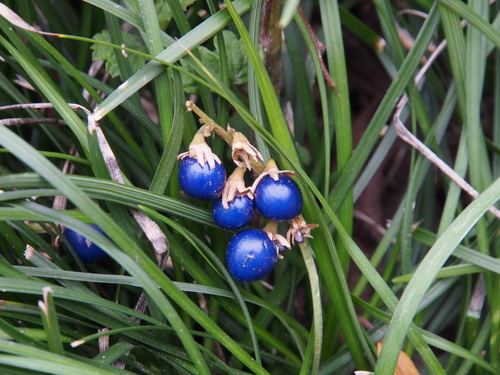
Ophiopogon japonicus, commonly called fountainplant, is an evergreen, sod-forming perennial. Its leaves are linear and measure 20–40 cm long. Flowers range from white to pale lilac, and are held in a short raceme on a 1 to 5 cm stem. The fruit is a blue berry 5 mm in diameter. Underground, this species produces large stolons with tuberous roots. It is cultivated as an ornamental plant, where it makes excellent groundcover. Several cultivated varieties have been selected for growing: 'Albus' with white flowers, 'Compactus' and 'Kyoto Dwarf' which are dwarf forms that do not grow over 4–5 cm tall, and 'Silver Mist' which is variegated with white-striped leaves. It is often sold as a decorative plant for freshwater aquaria, but it is not a true aquatic plant, so it only survives for a few months underwater before dying. When dormant outdoors in winter in normal soil, it is hardy to temperatures around –20°C. When kept fully submerged, it requires water temperatures between 18–25°C. It grows well in both full sun and partial shade, and can be propagated from side shoots. In traditional Chinese medicine, the whole plant and its tubers are known as mai men dong. Its tubers are used as a primary herb to treat yin deficiency. According to Chinese Herbal Medicine Materia Medica, this herb has a sweet, slightly bitter flavor and is slightly cold; it acts on the heart, lung, and stomach channels. It nourishes the yin of the stomach, spleen, heart, and lungs, clears heat, and calms irritability. Liriope spicata is frequently used as a substitute for this species.