About Ophiogomphus cecilia (Fourcroy, 1785)
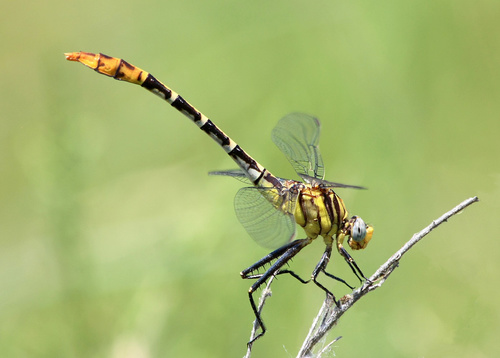
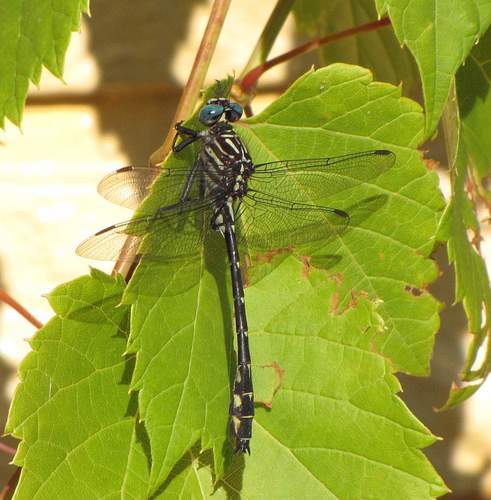
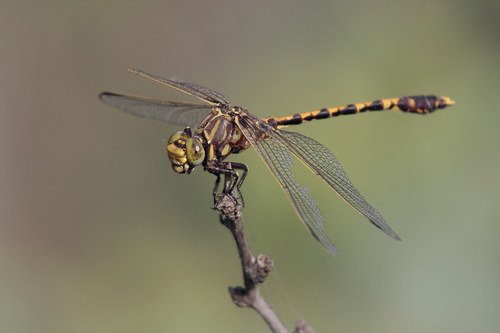
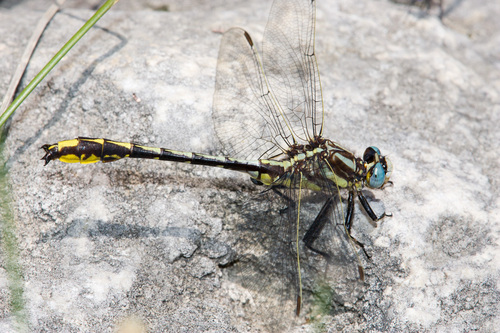
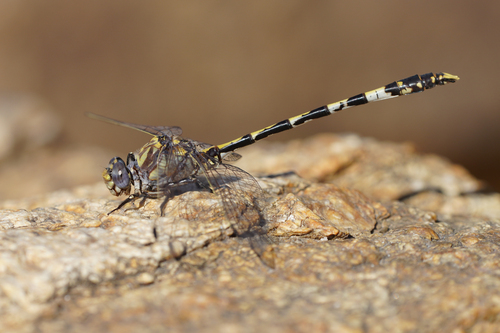
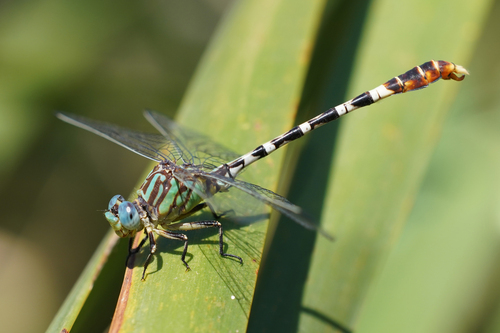
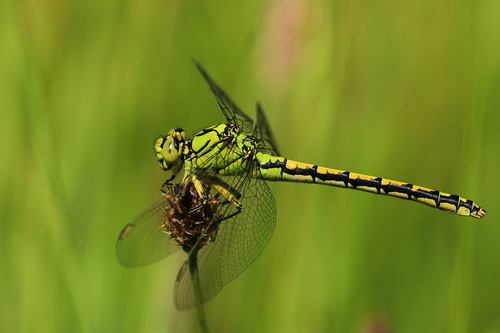
This dragonfly species is the only snaketail found in Europe. In overall coloration and river habitat preference, it resembles a large clubtail, but mature individuals have a vivid apple green front end, and males have short appendages. It is the largest dragonfly in the Gomphidae family apart from Bladetail, with green eyes and face, plus a green thorax marked with thin black lines on its top and sides; the side lines are similar to those seen on Yellow Clubtail and Western Clubtail. Green color extends to abdominal segment S2 at the base of the abdomen, while the rest of the abdomen carries a discontinuous yellow pattern through to segment S10. This pattern is generally broader than that on clubtails, with markings on segments S3–7 being more triangular in shape, and the abdomen is moderately clubbed at segments S8–9. Legs are extensively yellow, male appendages are short and yellowish, and female abdominal yellow markings are broader than those of males. Two tiny crests are present on the back of the head, between the eyes. In some individuals, the black lines on the thorax are reduced, and immature individuals do not show any green coloration. This species occurs in Austria, Belarus, Bulgaria, China, the Czech Republic, Denmark, Estonia, Finland, France, Germany, Hungary, Italy, Latvia, Lithuania, Luxembourg, Moldova, North Macedonia, Poland, Portugal, Spain, Romania, Russia, Slovakia, Slovenia, Sweden, Switzerland, Turkey, and Ukraine. Its main distribution area is in Eastern Europe. In Asia, its range extends to Kazakhstan, and it reaches northern Finland and northern Sweden in the north. There are only a few recorded finds from western and southern Europe. In Germany, it occurs mainly in the eastern parts of the country, including the Lüneburg Heath, the Oder, the Spree, Niederlausitz, and the central and eastern parts of Bavaria. The characteristic habitat of this species consists of creeks with a sandy-gravelly bottom, moderate flow speed, shallow water depth, partial shading from bank-side trees, and low pollution. Most recorded finds are from rivers and streams. Remaining occupied sites are spread across a wide variety of water types, but none of these other types serve as larval habitat. Of 2,700 exuvia collected between 1992 and 1994 at the mouth of the Swabian Rezat, most were found hanging on the banks of a five-meter-wide mill stream 50 to 120 cm deep, with a muddy to sandy bottom. Larger areas of this stream supported growth of Sparganium and/or Potamogeton. The slowly flowing water (0.2 to 0.4 m/sec) was 30% shaded by adjacent forest. Water width does not appear to play a decisive role for larval development, as the species develops successfully in both 1.5 m wide brooks and 50 m wide rivers in Bavaria. In Bavaria, hatching can begin as early as the second half of May in some years, and lasts well into August. The main flight period runs from the end of July to mid-August, and adults can be observed until the beginning of October. Adult males typically occupy sunny, exposed perching sites above running water, including plant stalks, branches that protrude over water, stones, and sandbanks. These sites are often characterized by agitated water flowing over shallow, sandy bottoms. Males defend these perching areas against other members of the same species, though conflicts are usually brief and non-violent. They do not establish fixed territorial boundaries, and individual males may frequent the same stretch of river for several days. Males avoid shaded areas, and will typically fly around areas bordered by wooded banks. Even after reaching maturity, adults sometimes move long distances away from their breeding waters. Males have been detected up to two kilometers from inhabited rivers, in sun-exposed hillside forests along valley edges, and individuals caught in these locations have later been found along the river. When sexually mature individuals were marked, the male-to-female ratio ranged between 16:1 at Rezat and 67:1 at Aurach. This ratio is explained by the secretive behavior of females during egg-laying. Females usually deposit their egg masses while hidden under dense vegetation, laying eggs in seconds by repeatedly dipping the end of their abdomen into the water, then immediately leaving the water area. There is also evidence that females visit breeding waters at separate times and locations from males. Larvae can reach relatively high population densities: up to ten larvae per square meter have been recorded on a stream in the northern Upper Palatinate. Larvae hunt both while burrowing in substrate and while moving on the substrate surface. They also practice ambush hunting, where only the front portion of the head capsule and the anal pyramid protrude from the substrate. Larval development usually takes three or four years, and may sometimes take only two. Hatching occurs close to the water's edge, and the sex ratio among exuvia is balanced. Hatching and adult flight areas do not have to be the same, and exuvia can be found in locations where adult dragonflies are only seen sporadically.