About Opheodrys vernalis (Harlan, 1827)
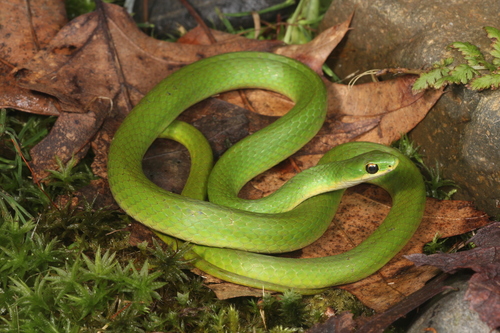
Opheodrys vernalis, commonly called the smooth green snake, has a slender build. Adults are classified as small-medium snakes, reaching a total length (including the tail) of 36–51 cm (14–20 in), and the maximum recorded total length for the species is 66 cm (26 in). The tail accounts for 1/4 to 1/2 of the snake’s total length, and males have longer tails than females. Its back is a uniform light green, and its belly is yellow or white. It has smooth dorsal scales, which contrasts with the keeled scales of the rough green snake. Its smooth dorsal scales are arranged in 15 rows at midbody. Newly hatched smooth green snakes have different dorsal coloration than mature individuals: juveniles may be olive green, blue-gray, or brown, but they gain their characteristic bright green color after their first shed. Dorsal coloration also varies by location: individuals are bluish in Kansas, olive-tinted light brown in southeastern Texas, and bronze in northern Wisconsin. This snake has a red tongue with a black tip, which it flicks in and out of its mouth to detect scents from its surroundings. The smooth green snake is native to the Nearctic region. Its range extends through southeastern Canada, west to Saskatchewan, and south through Illinois and Virginia, with additional scattered populations in Wyoming, Colorado, New Mexico, Iowa, Missouri, Texas, and northern Mexico. This species occupies a variety of habitats including marshes, meadows, stream edges, and open woods. It prefers open, ground-level areas with few shrubs, and favors moist locations near permanent water sources, typically staying in green vegetation for camouflage. As an ectotherm (cold-blooded animal), it prefers warm areas and will bask in the sun on rocks and logs, which it also uses for hiding. During hibernation, it seeks out burrows, ant hills, and other dug-out underground sites, and usually gathers in large groups there. Sexually mature smooth green snakes mate in late spring or summer, and gravid females lay eggs from June to September. Females typically lay two clutches per season, each containing 4 to 6 eggs. Eggs are most often laid in rodent burrows, mounds of rotting vegetation, sawdust piles, or rotting logs. Communal nesting has been observed in the northern part of the species’ range. Smooth green snake eggs are white, oval, thin-shelled, and approximately 2.5 cm (1 inch) long, with an average mass of 2.6 grams per egg. Eggs hatch between 4 and 23 days after being laid.