About Opheodrys aestivus Linnaeus, 1766
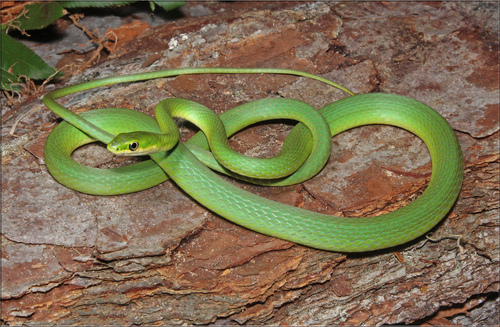
The rough green snake, Opheodrys aestivus, is bright green on its upper body with a yellowish belly. This coloration gives it excellent camouflage in green vegetation, making it hard to spot in the wild even though it is relatively common within its range. It has keeled dorsal scales arranged in 17 rows at mid-body. This is a very thin species that can grow up to 116 cm (45+3⁄4 in) in total length, including the tail.
Rough green snakes range across the southeastern United States, extending from Florida north to southern New Jersey and Indiana, and west to central Texas. They are common in the Piedmont and Atlantic coastal plain, but do not live in the higher elevations of the Appalachian Mountains. This species is also found in northeastern Mexico, including the state of Tamaulipas and eastern Nuevo León.
The preferred habitat of Opheodrys aestivus is moist meadows and woodlands, most often located near water. It is highly arboreal, and favors a narrow arboreal microhabitat of dense brush in edge environments. This microhabitat occurs across a range of habitat types, including lakeshores, streambanks, and upland ravines. For individuals kept in captivity, it is recommended to house them in a taller enclosure with plenty of cover and opportunities for climbing. Rough green snakes are frequently found climbing in low vegetation, and are also good swimmers, but they are often seen on the ground as well. Unlike many snake species, rough green snakes are largely diurnal. At night, they rest coiled in tree branches. The snakes choose perches based on distance from the shoreline, branch height, and individual branch thickness.
Male rough green snakes reach sexual maturity at 2 years of age, when they reach around 245 mm in length. Females reach sexual maturity between 1 and 2 years of age, when they measure between 350 and 400 mm in length. For mature males, plasma androgen levels and the diameter of the sexual segment of the kidney follow a bimodal cycle, with one peak in spring and a second in late summer. Spermatogenesis begins in June and peaks in July and August, following a post-nuptial cycle. Rough green snakes breed in spring, and occasionally breed a second time in fall. Male courtship behaviors include head-jerking, tail-waving, and chin-rubbing. On average, males align their copulatory organs with females in 2 minutes and 45 seconds, and copulation lasts an average of 16 minutes and 4 seconds. Females lay 2 to 14 eggs per clutch, and will occasionally lay eggs in a communal nest shared by multiple females; up to 75 eggs have been recorded in a single communal nest. Nest sites can include locations under boards, under bark in rotting stumps, deep mulch, or under rocks. Hatchlings from spring breeding typically emerge in August or September, and each hatchling measures around 18–20 cm (7.1–7.9 in) in total length. After reaching maturity at two years old, males begin storing large amounts of sperm in their vas deferens, and are able to mate the following spring, in their third year of life.