About Onthophagus taurus (Schreber, 1759)
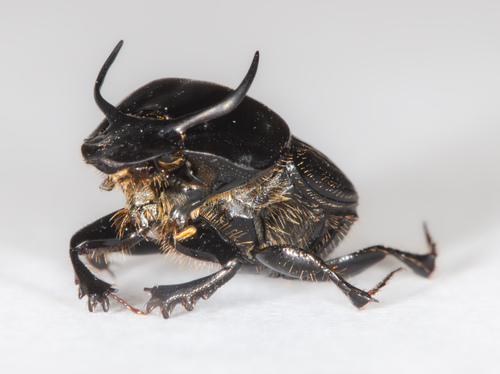
Onthophagus taurus, commonly called the taurus scarab or bull-headed dung beetle, is a dung beetle species belonging to the genus Onthophagus and family Scarabaeidae. This species specializes in feeding and breeding in cattle dung, and is widely used to keep pastures clean, making it agriculturally valuable. Adults of this species typically measure 8–10 millimetres (0.31–0.39 in) in length. They are small, oval-shaped beetles, usually black or reddish brown in color; sometimes their pronotum has a faint metallic sheen. Males of this species display distinct horn variation: large "major" males have long, sweeping, curved horns that resemble the horns of a longhorn bull, while small "minor" males only have tiny horns that project upward from the back of the head. Females have no horns at all. Onthophagus taurus is native to regions with Mediterranean climate, originating from central and southern Europe and Asia Minor, with a native range stretching from Spain to Morocco, Turkey, and Iran. This species was intentionally introduced to the United States and Australia in the late 1960s to early 1970s to manage cattle dung. The goal of this introduction was to bury cattle dung from pastures underground, to improve soil health and control pest populations. It is most abundant in grassland habitats where cattle live. Today, O. taurus can be found in Australia, Europe, Morocco, Algeria, Tunisia, Syria, Iraq, Transcaucasia, Asia Minor, Iran, Afghanistan, Central Asia, and the United States. O. taurus was accidentally introduced to eastern North America, with the first confirmed sighting in Florida in 1971, followed by later spread to the northeastern United States. Based on its population size and spread pattern, researchers hypothesize that O. taurus most likely entered the United States through the coastal area of Florida. After this accidental introduction, the United States Department of Agriculture deliberately released O. taurus at multiple locations, including California, Texas, and New Jersey. This intentional release led to a large expansion of the species' range beyond the original accidental introduction site. O. taurus develops best at temperatures between 16 °C and 23 °C. Extremely cold regions limit its reproductive success, which restricts the species' distribution to warmer areas. In 1974, O. taurus was introduced to Australia from source populations collected in Spain, Greece, and Turkey. Within just two years of its introduction, it became the most common non-native dung beetle species in southwestern Australia. It even displaced Onthophagus binodis, an earlier introduced dung beetle species, and has overtaken O. binodis across much of Australia.