About Onopordum acanthium L.
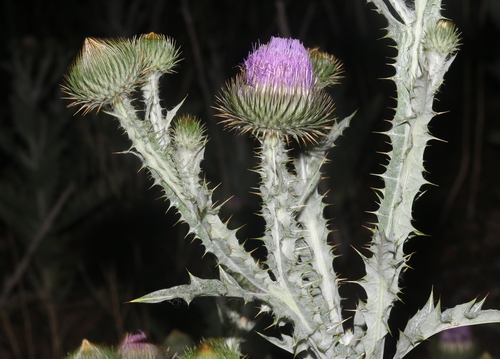
Onopordum acanthium L. is a plant commonly known as cotton thistle or Scotch thistle. It is typically a biennial plant. In its first year, it produces a large rosette of spiny leaves. Plants usually germinate in autumn after the first rains, remaining as rosettes through their first year. During this time, they develop a stout, fleshy taproot that can extend 30 cm (12 in) or deeper to store food reserves. In the second year, the plant can grow up to 3 m (9.8 ft) tall and reach up to 1.5 m (4 ft 11 in) in width. Its leaves are 10–50 cm (3.9–19.7 in) wide, alternate, spiny, and often covered in white woolly hairs, with the lower leaf surface more densely covered than the upper. Leaves are deeply lobed, with long, stiff spines along their margins. Fine hairs give the entire plant a greyish appearance. The massive main stem can be 10 cm (3.9 in) wide at the base and is branched in its upper portion. Each stem has a vertical row of broad, spiny wings (conspicuous ribbon-like leafy material), typically 2–3 cm (0.79–1.18 in) wide, that extends all the way to the base of the flower head. Flowers are globe-shaped, 2–6 cm (0.79–2.36 in) in diameter, and range in color from dark pink to lavender, produced during the summer. Flower buds form first at the tip of the main stem, and later at the tips of axillary branches. Flowers appear singly or in groups of two or three on branch tips. This species is androgynous, with each flower producing both pistil and stamens. Flowers sit above numerous long, stiff, spine-tipped bracts that all point outwards; lower bracts are spaced wider apart and point downwards. After flowering, the ovary swells to produce seeds, with each individual plant generating between 8,400 and 40,000 seeds. This species is native to Eurasia. It prefers habitats with dry summers, such as the Mediterranean region, and grows best in sandy clay and calcareous soils rich in ammonium salts. It grows in ruderal areas, dry pastures, and fields. Its common habitats include natural areas, disturbed sites, roadsides, fields, and especially sites with fertile soil, agricultural areas, range and grasslands, riparian zones, scrub and shrublands, valleys, plains, and areas alongside water courses. For Onopordum species, ecological performance is determined by temperature and moisture, rather than soil nutrient concentrations. In Europe, the plant tends to colonize disturbed pastures. Within its native range, cotton thistle is considered a weak competitor that requires open regeneration gaps to develop and maintain stands; populations tend to recede when disturbance stops. It has been widely introduced across much of mid-latitude North America, and Scotch thistle can spread very rapidly. For example, it was first recorded in Utah in 1963. By 1981, it covered approximately 6070 hectares across 17 Utah counties. Eight years later, it had spread to cover more than 22,540 hectares across 22 counties. Onopordum acanthium reproduces exclusively by seeds. Most seeds germinate in autumn after the first rains, though some seeds can germinate year-round when moisture and temperature conditions are favorable. Seeds that germinate in late autumn develop as biennials. Seeds that germinate earlier can behave as annuals. Buried seed can remain viable in the soil seed bank for at least seven years, and potentially up to twenty years or more. Annual seed production and seed dormancy are highly variable, depending on local environmental conditions. The slender, smooth achenes (dry seeds) are around 3 mm long, brown with gray markings. They are tipped with a pappus of slender bristles. Seeds are mainly dispersed locally by wind, and dispersed more widely by humans, birds, wildlife, livestock, or streams. Seeds are sensitive to light, and only germinate when they lie close to the soil surface. Seedlings can emerge from soil depths up to 4.5 cm, with 0.5 cm being optimal for emergence. While some seeds will germinate in the dark, most germination occurs under alternating light and dark cycles, with an optimal day length of eight hours. The leaves of cotton thistle are eaten by caterpillars of some Lepidoptera species, such as the thistle ermine (Myelois circumvoluta). Onopordum acanthium is grown as an ornamental plant valued for its bold foliage and large flowers. It has historically been used to treat cancers and ulcers, and to reduce discharges from mucous membranes. A recent study of a crude leaf extract from the plant demonstrated activity against glioblastoma, a very malignant type of brain tumor. In earlier times, its receptacle was eaten similarly to an artichoke. The cottony hairs on its stem have been occasionally collected to stuff pillows. Oil extracted from the seeds has been used for burning and cooking. Thistles including this species produce abundant nectar for pollinators, and provide seeds and floss for birds such as the goldfinch. Large-flowered tall thistles in particular provide considerable nectar.